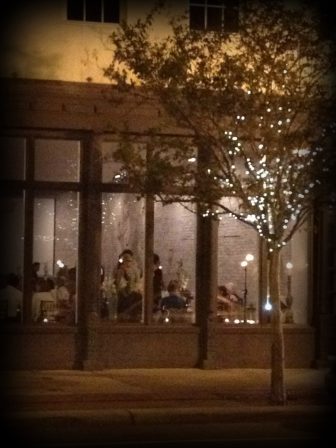

Morning at The Kalamata.

Saturdays bring a delight to our weekends, especially when we change our routine.  For something a little different, last Saturday, mid-morning, we headed out to The Kalamata Kafé.  We weren’t disappointed.

The simple brunch was nothing short of pleasant; it was one of those simple meals that somehow feels like a small private celebration.  Soft violin music emanated from the ceiling speakers.  The waitresses were modestly dressed in pure white short togas tied at the waist with gold belts.  My companion ordered a knish—a strangely sweetened roll made from a dough similar to pillowy Hawaiian‑style bread.  It was filled with soy chorizo and melted queso chihuahua (an imported cheese), a combination that gave it a savory kick and a five-fingered punch beneath the sweetness.  I took a small bite and so did my companion; it was unlike anything either of us tried before, unexpected in the best way, and definitely memorable.  I ordered an almond croissant sprinkled with sugar and sliced toasted almonds, still warm from the oven, its flaky layers giving way to a soft, fragrant center touched with just enough sugary depth.  A cup of weak lemongrass tea sweetened with mesquite honey for the two of us gave the oomph our light brunch needed.

Afterward, we strolled up the bay, the morning light glinting off the water, then we looped back along the main road where the breeze carried the scent of salt and sun-warmed sand.  The walk stirred up memories for both of us—those long rides we used to take on the Indian Chieftain, chasing the horizon with nothing but vast open road ahead.  Only this time, the adventure came with greater comfort, steadier footing, and a quiet sense of security that felt like its own kind of freedom.  We eventually found our car, hopped in, and headed back home.  Later that day, the soy chorizo-queso chihuahua knish thing didn’t agree with my companion and we spent the late afternoon paying for it dearly.

We’ll go back to The Kalamata, but with a different menu ordering plan.


The Age of Performed Identity.

How much of our lives have we spent trying to be something—or someone—we’re not?  It is one thing to pursue growth, to refine our character, and to enrich our inner life, yet it is quite another to adopt a false identity for the sake of impressing others, whether for money, status, or the fleeting approval of strangers, family, and acquaintances.

Lately, it seems that the art of pretending has become a widespread habit, a kind of cultural contagion.  Over the past decade especially, I’ve watched this phenomenon snowball.  It has become easier and fiendishly tempting to put on a polished façade while abandoning genuineness, humility, and empathy.  Social media, with its curated illusions and endless opportunities for self‑promotion and keyboard commandos, has been the chief purveyor of these false faces.

And how easy it is.

In a world moving at swift speed, the pressure to perform seems to be ceaseless.  Some people feel compelled to reinvent themselves for every audience, to appear more educated, more virtuous, more high class, more enlightened than they truly are.  Some people, unfortunately, strain to become the moral authority in every conversation, to project wisdom they have not earned, and to cloak their insecurity in a thin veil of false humility.  Some people invent and re-invent their live story continuously.

It must be exhausting.  From my vantage point, watching someone puff himself up by preaching from an imaginary pulpit, presenting himself as all‑knowing while sprinkling in counterfeit modesty, or looking down their nose at others, is a disheartening sight.  There is nothing admirable in self‑inflation or pretend self-deflation.  It does not elevate a person; it exposes him.  False humility serves only the ego.  It leaves no room to serve God, despite all their claims of “thanking God everyday” for such-and-such.  It comes across Pharisee-like when you know their true history and that they are putting on a public show.

Putting on an act for selfish gain is, at its core, a fabrication of the truth.  Duplicity demands constant maintenance, and after a while, there is so much maintenance that fabrication becomes sloppier and sloppier.  One must remember every false detail with perfect precision just to keep the fiction intact, and that’s the hard labor one has to do for a hollow reward in the prison of their mind’s fantasy.

It is far better to remember that the one thing you can do better than anyone else is to be yourself.  Of course, one could make the argument that being phony for some people is “being themselves.  Yet there is less work and stress to admit one’s true self and not make up stories to impress an audience.  Or in one case, I have seen one person who has shared his childhood as first “middle class,” then defined it as “not quite middle class,” to the sad Dickensian tale of “being poor.”  Is that the “fake it until you make it” mantra at work, or the pretend “rags to riches” story?  I won’t bother to hazard a guess.  All I can say is I have little regard for counterfeits.

The world does not need more people parroting platitudes or mimicking the latest persona.  It needs more of the original, the sincere, the unvarnished.  Pretending to be someone else is not only dishonest because it is truly a quiet betrayal of your own dignity.

As we step into another day, we should do so with sober eyes and clear hearts.  Remember who you really are beneath the noise and the pressure, and do not compromise that reality.  Be honest, be considerate, and be grounded in your principles.  Respect yourself and extend that respect to others.


Leaving the Secular Carousel.

A Reflection on the Gradual Reordering of My Life

Over these many, many years as I have been becoming more and more serious about my Catholic faith, I have noticed a remarkable change in myself—one that has unfolded slowly, almost imperceptibly at first, but unmistakably over the last fifteen years or so.  In this article, I write about how the secular world has been shrinking in my life, not out of disdain for the people in it, but because its offerings no longer nourish me.  I have been moving away from many secular things, both by deliberate choice and by the quiet providence of circumstance.  What once occupied my time, my attention, even my imagination, now feels strangely distant, as though it belonged to someone else’s life.

In my youth, I wasn’t a fan of modern music, particularly rock and roll.  But in my sophomore year, one morning while getting ready for school, I tuned into the local rock radio station to find out what the current music fad was all about.  My friends were into that music, and I didn’t want to be left out of conversations.  It felt harmless enough—just a way to fit in, to understand what everyone else seemed to enjoy.

Over the years, my taste in music expanded to that genre, though it never went into grunge or the harsher styles that followed.  But now, even that earlier music has become distasteful to me. The beat and melody might still be attractive, but the lyrics—so often vulgar, suggestive, or simply empty—are sickening.  That’s what gets people hooked: catchy rhythms and memorable musical notes.  The lyrics are an afterthought, or worse, a poison pill wrapped in sugar. I find myself wondering why I ever tolerated it, let alone enjoyed it.

The same goes for television programs.  I didn’t grow up in a house where the television was constantly on.  Until age sixteen or so, television was rare—a special thing to watch, almost an event.  But then something shifted, and before long meaningless programs like Happy Days, Laverne and Shirley, Three’s Company, WKRP, and various variety shows were playing regularly in our home.  Looking back, I am appalled that I allowed myself to waste time on such trivia: scantily clad people, taking God’s name in vain, sexual innuendo, name-calling, yelling, and cheap, vulgar laughs.  I don’t even find those programs funny or edifying now.  The detective and cop shows might have been tolerable—good guys catching bad guys—but even those were repetitive, predictable, and shallow.  And for what?  To kill time in the evening?  Why did I watch that garbage when I could have been reading good books, learning something worthwhile, or helping around the house?

Unfortunately, I was in a marriage once many moons ago where the television dominated the household the moment he walked through the door.  It stayed on until bedtime, a constant drone that filled every corner of the evening.  And even then, the bedroom television (yes, the senseless bedroom television) often blared until 11:30 PM.  That kind of environment was never for me.  I complained, he questioned why I wouldn’t watch because I’d have to have something to talk about at work in the morning with my co-workers.  I replied that I talked to my co-workers about work, not some stupid television program; that’s what I was paid for— work!  I tried to carve out pockets of quiet, busying myself with anything that felt less corrosive, but the noise was relentless, and the contrast between what I longed for and what surrounded me grew sharper with time.

Now that I have been away from television entirely for a good eighteen years, I don’t miss any part of it.  I couldn’t tell you what the latest shows are, or even if there are any worthwhile.  Yes, I still own a television, and I’ve used it to stream old movies from time to time, but even that has gone by the wayside for Lent this year, and I may not return to it afterward.  I don’t miss it.  I don’t crave it.  Its absence feels like fresh air.

And then there is social media—another thorn I am trying to remove.  It is astonishing how easily it lures, distracts, and scatters the mind. Even when I think I am using it “responsibly,” it has a way of pulling me into trivialities, arguments, or endless scrolling.  It promises connection but often delivers agitation.  It promises information but often makes noise.  It promises community but often fosters comparison and restlessness. I am working slowly but steadily, to loosen its grip.

Over time, these renunciations—vapid music, insipid television, thieving social media—have revealed something deeper than mere preference.  They dull the mind, yes, but more importantly, they crowd the soul.  By tossing them aside, I have begun to see the shape of my interior life gradually reclaimed.  What once felt “normal” now feels foreign, and what once seemed harmless now appears hollow.  I find that the less I cling to the secular world, the more interior freedom I gain.  This is not withdrawal but refinement: a quiet choosing of what leads me toward God and a holy life and away from the emptiness and noise that once filled my days.  In that choice, I am discovering a steadier, simpler, more meaningful, and far happier way to live. I write more, I pray more, I read more, I use my life better.


Losing It with Quiet Discipline.

I have long known that the most reliable way to lose weight is also the least glamorous: change the way I eat, and do it without powders, liquids, pills, or any of the other gimmicks that promise transformation without effort.  They don’t work.  Real change comes from willpower, ordinary food, and an honest attitude.  These matter more than any trend.

This year, my efforts began even before Lent arrived.  A goal of losing eight pounds is losing eight pounds for more energy and just feeling better overall.  As January unfolded, I found myself preparing not only my interior life but also my habits.  I started cutting down on unnecessary snacking that crept in after supper.  Sure, I still indulged in a snack here and there, but it wasn’t gorging myself.  I continued my quiet campaign against corn syrup and the sugary additives that hide in so many foods.  And I returned to simpler cooking—meals that didn’t need to resemble anything from a fancy restaurant menu.  I proved to myself that I can cook anything well, so why do it every day?  That should be saved for special occasions.  Then I returned to meals that I grew up on that nourished rather than entertained.  There was a certain relief in that simplicity.

By the time Ash Wednesday arrived in mid‑February, I wasn’t scrambling to begin anything new.  I was simply continuing what had already taken root and ramping it up a bit.  The weight began to come off, slowly and steadily, and it still does.  But more importantly, the discipline of eating differently began to shape the discipline of living differently.

Attitude is half the work.  I stopped letting the noise of the secular world dictate my mood or my focus.  I ignored the foolishness that swirl around in headlines and conversations.  Instead, I turned my attention toward things that actually strengthen the soul: spiritual reading that lifts and edifies the mind and praying the Rosary with attentive meditation rather than mindless haste.  These practices didn’t just support my physical goals—they steadied my interior life.

There is a quiet joy in sacrifice when it is chosen freely and offered with purpose.  Lent simply gave me the structure to continue what had already begun: a return to simplicity, a clearer mind, and a heart more anchored in God than in the world’s distractions.

In the end, this has reminded me that caring for the body and caring for the soul are not competing tasks but parallel ones.  The more I simplified my meals, the more I found myself craving a simpler interior life as well — one less cluttered by noise, distraction, and the endless commentary of the world.  Lent simply gave shape to what I already sensed: that discipline is not a burden but a quiet form of freedom, and that small, steady acts of intention at the table and in prayer can reshape a life from the inside out.


The Profit That Destroys.

The question, “For what shall it profit a man, if he gain the whole world and suffer the loss of his soul?” cuts to the heart of a tension that every era rediscovers: the difference between a life that looks impressive and a life that is actually worth living.  We are surrounded by metrics — influence, fame, money, reputation, achievement, status — that promise satisfaction but often deliver only more insatiable hunger.  The question forces us to confront a truth we instinctively know: a person can win by every external measure and still feel hollow inside, a dried-up husk of a person.

Modern culture is skilled at rewarding the wrong things.  It celebrates accumulation, visibility, and speed.  It teaches us to optimize our schedules, polish our image, and chase the next milestone.  None of these pursuits are inherently harmful, but they become dangerous when they eclipse the quieter, more essential work of becoming a whole human being.  A person can spend decades climbing a ladder only to discover it was leaning against the wrong wall.

Losing oneself rarely happens in a dramatic collapse. More often, it happens gradually, when convenience replaces integrity, when ambition overrides relationships, when the greedy pursuit of More! More! More! crowds out the pursuit of meaning.  The world applauds these compromises; our inner life does not.  The cost is subtle but real: a thinning of character, a shrinking of joy, a sense that life is happening faster than we can live it.

To gain the world is easy.  It requires only that we follow the current cultural expectation.  To keep oneself intact is harder.  It demands reflection, boundaries, and the courage to choose depth over display, but only one of these paths leads to a life that feels like one’s own.

In the end, the question remains a challenge to every generation: what good is success if it costs you the very person you were meant to become?  The world offers many rewards, but none of them are worth the loss of yourself and your eternal spirit.


The Gentle Art of Wholesome Reading.

There is a particular enjoyment in reading good, wholesome books— a joy that feels almost old‑fashioned in the best possible way.  These are the books that don’t shout for our attention or compete with the noise of the world because they simply open a door and invite us into a place where I can breathe.

Wholesome books remind us that goodness is not naïve, that beauty is not fragile, good language is a delight, and that truth can be spoken without cynicism.  They offer characters who struggle honestly, worlds that lift rather than darken, and stories that leave us a little more human than they found us.  In a culture that often rewards vulgarity, shock, and spectacle, these books feel like a quiet rebellion.

There is also a deep restfulness in them. When we read something good and clean and true, our minds unclench.  We remember that gentleness is not weakness and that hope is not foolish.  Even a simple story told with sincerity can become a small refuge.

And perhaps that is the greatest joy of wholesome reading: it forms us.  It shapes our imagination toward the good.  It teaches us to look for light, even in ordinary places.  It reminds us that the world is still full of things worth loving.

A good book doesn’t just entertain; it nourishes us, and in a time when so much reading leaves us scattered or weary, finding a book that restores us is its own quiet ways.

So far this year, I have read the following good books.  They are in the order of publication year.

Seeking the Heart of Christ by Saint Claude La Colombière (1680)

Ole Mammy’s Torment by Anne Fellows Johnston (1897)

Light and Peace: Instructions for Devout Souls to Dispel Their Doubts and Allay Their Fears by Carlo Guiseppi Quadrupani (1980)

The Wisdom of Fulton Sheen: 365 Days of Inspiration (2020)


The Decline of Language Originality.

Have you noticed that our language has gone stale?  Once vibrant words and phrases have been replaced by a handful of recycled expressions that people toss around as if cheap confetti.  We’ve become a culture of verbal shortcuts—catchphrases, memes, and pre-chewed reactions—leaving very little room for originality, nuance, or even basic thought.

So perhaps it’s time to retire a few of these linguistic relics and replace them with something more intelligent, more intentional, and frankly, more dignified.

Take cringe, for example.  This single word now is deployed as a universal dismissal, a way to avoid forming an actual opinion.  Instead of describing what makes us uncomfortable or why, we simply slap the “cringe” label on it and move on.  It’s the conversational equivalent of shrugging.

Then there’s the ever popular “What! What?”  That’s a phrase that pretends to express astonishment but usually signals nothing more than performative confusion.  It’s noise masquerading as reaction.

And of course, the internet’s favorite template:  Tell me you’re ____ without telling me you’re ____.  Perhaps it was a clever structure the first time it appeared, perhaps even the second time.  But now it’s a tired formula, a linguistic Mad Libs game that saves us from the burden of crafting an original thought.

“How cool is that?” has also run its course.  It’s a placeholder, a filler, a way to feign enthusiasm without committing to any real sentiment.  It’s a way for the older generation to be hip with the kids.  It’s the verbal equivalent of nodding politely while thinking about something else.

“The fourth be with you”—a absurd pun that has lived far, far beyond its natural lifespan and continues to resurface every May, as if repetition alone could make it clever again.

And finally, there’s IYKYK (“if you know, you know”).  Here’s a phrase that pretends to signal insider knowledge but usually functions as a way to avoid explaining anything.  It’s exclusivity without substance.

Here’s a list of my suggestions of clichés and phrases we need to retire post haste:

Glow Up

Gaslight

Today years old.

Narcissist / Narcissism

Tell me you’re ____ without telling me you’re ____.

Chilling (as in, “chilling details,” “chilling video,” et cetera)

W’s (or anything using “W” for the word “win.”)

May the fourth be with you.

Awesome / Amazing

Asking for a friend.

You (We) got this!

How cool is that?

Game changer

Wait!  What?

IYKYK

Literally

Cringe

Iconic

The “F” word

These expressions are simply worn out, dehydrated by overuse, leaving behind only the dry husk of what once felt fresh.  Language deserves better, and so do we.  Thoughtful speech invites thoughtful living.  When we choose words with care, we sharpen our minds, deepen our conversations, and reclaim a bit of originality in a world that keeps trying to flatten everything into sameness.

If we want richer conversations, we must start by choosing richer language.  Retiring these worn-out phrases isn’t about being pretentious; it’s about making room for clarity and genuine expression.  In a culture that thrives on shortcuts, choosing real words might just be the most radical act of all.


The Stankles.

I lived in a large mid‑rise building, the kind with long hallways, welcoming vestibules, perpetually humming vents, and a cast of neighbors who could each anchor their own documentary.  Life at the Sage Pointe Condominiums was never dull, especially if you had a sensitive nose.  In today’s essay, I’d like to introduce you to one of our more… aromatic residents.  I have lived in buildings that have friendly doormen or fresh flowers in the lobby, and a dedicated cleaning crew that cleaned and deodorized a couple times a week.  However, at Sage Pointe Condominiums we had odors—layered and evolving.

Whenever I opened my front door or step off the elevator, I braced myself.  I never knew what invisible cloud would greet me, or what new olfactory assault would come barreling toward my unsuspecting nose.

The most infamous contributors were Adonis and his family, whom I privately referred to as The Stankles.  If it were scientifically possible for a scent to take physical form, they would have travelled through life surrounded by a perpetual soft green fog, something between a cartoonish stink cloud and a government chemical weapons test.  Each member of the family seemed to believe that the only way to apply cologne was to marinate in it.  Not spritz.  Not dab.  Marinate.

When that throat‑tightening, eye‑watering haze slapped me across the face, I know exactly what it means: The Stankles had either left for work and school or had triumphantly returned.  They lived on the opposite end of the hallway from me, which maked the reach of their fumes all the more impressive.  For the stench to drift all the way to my wing, it must have been clinging to them like a second skin, and through all seven layers, too.

I imagined inside their condominium.  In my mind, a greenish mist hung in the air like a permanently stagnant weather system.  The scent must have ripened throughout the week, as it settled into the carpet, the curtains, the couch cushions, the walls; every surface absorbing a different note from each family member’s chosen fragrance.  One of them preferred something sharp and citrusy, another something musky and sweet, another something like patchouli mixed with body odor, and yet another something that smelled like a gas station bathroom trying its best.  The combination was… unique.

The elevator, of course, had its own adventure.  It faithfully recorded the comings and goings of the building’s most pungent citizens.  Step inside, and you could tell instantly whether The Stankles had recently passed through.  But they weren’t the only ones who left their mark.

There’s The Princess, whose perfume was so distinctive it might as well be trademarked.  She rocked through the building with her dogs like a scented comet, leaving behind a shimmering trail of powdery, floral, dirt, and a slightly sweaty body odor insistence.  And then there was the unmistakable contribution of The Weede Family, whose fusty skunk aroma drifted through the vents with the determination of a creature lazily seeking freedom.

Their stories and their scents deserved essays of their own.  And believe me, I’ll get to them in future essays.  Life at the Sage Pointe Condominiums provides no shortage of material.  For now, consider this your first whiff of the cast of characters who made my building unforgettable in ways I never asked for.

Erosion of Thought and Thinking.

This past weekend came and went in a blur—swift, full, and satisfyingly productive.  I don’t think I had ten consecutive minutes of idleness, except during sleep, and truthfully, I relish weekends like that.  There is a certain peace that comes from purposeful accomplishments.

In one of my conversations over those busy days, a curious topic surfaced: the increasing need to remind people—again and again—about the simplest responsibilities.  A bill due.  An appointment scheduled, a task promised, or a basic, everyday obligation.  I remarked that in these present times, many people seem capable of focusing on only one thing, whether it be children, grandchildren, entertainment, work, or some other singular preoccupation.  Everything else, such as duties, commitments, even common courtesy, all fall by the wayside.

It has become difficult to hold a meaningful conversation with someone whose world has narrowed to a single point.  The most engaging and educated people, in my experience, are those who can move gracefully across topics, who can offer insight, curiosity, and a well-formed exchange of ideas.  But to enter into conversation only to discover that the other person can speak of nothing beyond their kids or chasing the almighty dollar, a meaningless sports statistic, or their favorite sports team quickly becomes futile.  Unfortunately, the dialogue collapses before it begins.

Alongside this narrowing of attention, there is also a rising tide of blatant selfishness, that inward curl of the human heart that makes genuine engagement even more difficult.  Many people have become so absorbed in their own preferences, comforts, and routines that they no longer consider how their choices affect others.  Commitments are treated casually, responsibilities are postponed indefinitely, and the smallest inconvenience is met with irritation rather than maturity.  It is as though people have allowed themselves to be trained to prioritize their own ease above all else.  This self‑preoccupation doesn’t merely strain relationships; it impoverishes the soul.  A life turned inward eventually collapses under its own smallness and vapid reality.

Something has shifted in recent years, revealing a kind of dullness and a thinning of interior life.  Perhaps it stems from weakened social skills, the isolating effects of social media, the aftershocks of the scamdemic years, a decline in religious grounding, or some combination of these.  Whatever the cause, the result is the same: many lives have grown small, distracted, and strangely brittle.  And in that narrowing, something essential and human seems to have been lost.

If anything, these observations should stir in us not frustration but a quiet resolve.  We cannot control the narrowing of other people’s worlds, but we can refuse to let our own shrink.  We can choose to cultivate curiosity, to read widely, to think deeply, to converse generously.  We can reclaim the art of attention—toward religion, toward others, toward the responsibilities entrusted to us.  Renewal begins not with grand gestures but with the simple decision to live awake in a culture that drifts toward distraction.  If we desire a richer, more meaningful world and personal life, we must first become richer, more meaningful people who are anchored, attentive, and alive to the fullness of life that really is intended for us.


Website Built with WordPress.com.

Up ↑