When the Hallways Talk.

A short story from the past.

For hours, JeVaughn Willard sat in his recliner, frowning at the sporadic thuds and rolling rumbles echoing through the Sage Pointe Condominium building.  He took another puff of his Kools and listened hard.  The sounds came and went with no discernible pattern, bouncing off the walls and rattling his nerves.  He strained his ears, trying to pinpoint the source, but the building’s acoustics made it maddeningly elusive.  He slid out of his recliner and ambled over to the picture window.  He pushed aside the slats of the Venetian blinds and was glad he was not in the howling thunderstorm.  JeVaughn returned to his recliner.

As the clock struck eight, he took a break from reading his latest mystery novel.  His overflowing garbage bin finally gave him a reason to investigate the noise in the hallway.  He grabbed the bag and shuffled out into the dimly lit hallway, trying to keep his ragged brown corduroy slippers from flying off of his feet.  The carpet muffled his footsteps, but the strange racket had grown louder.  Then, as he rounded a corner, the mystery revealed itself.

Two neighborhood kids, the brood of the Reverand and Mrs. Stankle, were tearing up and down the long corridor, kicking a slightly deflated soccer ball between their feet.

Bam!  The ball slammed against a wall, leaving a faint smudge before careening into the air.

Thud!  The ball rebounded off the ceiling, narrowly missing a flickering light sconce as it came down.

JeVaughn Willard sighed, the corners of his mouth twitching with restrained annoyance.  He trudged to the garbage chute and let the bag drop with a hollow clang, watching it disappear into the void.

“Pointless,” he muttered under his breath, sparing one last glance at the kids.  They laughed and shouted, blissfully unaware of their disruptive echoes.

JeVaughn tightened his terry cloth robe and shuffled back to his door.  “No use mentioning it to their parents,” he thought grimly.  “The reverend’s sermons are loud enough.  I don’t need him aiming one at me!”

On Winning the Lottery.

I sometimes wonder what I would do if I suddenly won the lottery, not in the frantic, daydreaming way people often imagine, but in a quieter, more interior sense.  What would it reveal about me?  What would it change, and what would it leave untouched?

The answer, I’ve realized, depends less on the amount and more on the person receiving it.  A small windfall would be a pleasant gift for my husband, perhaps a chance to take a trip I’ve dreamed about for years.  But a larger sum such as hundreds of thousands, even millions, in fact, invites deeper reflection.  It asks who I am beneath the surface of daily routines and practical decisions.

If such a blessing ever came my way, my first instinct would be to give.  I would write a check to my parish, trusting that the funds would be used where the need is greatest.  I would finally visit the old country, reconnecting with my family there, and eventually stepping into the pilgrimage sites that shaped my imagination long before adulthood did.  I would sell my current home and settle into a condominium in a quieter corner of the state, close to a traditional Catholic parish where the Latin Mass still rises like the beautifully fragrant incense from another century.

But beyond those changes, I know myself well enough to see what would remain the same.  Wealth would not tempt me into reinvention.  I wouldn’t adopt a grand accent or cultivate airs.  I wouldn’t trade smoked chubbs or oxtails for some curated, fashionable palate.  I wouldn’t suddenly require a staff to manage my life.  I would keep my one car until it sighed its last breath.  I would continue wearing the clothes I already own, cooking the meals I already enjoy, and living with the same simplicity that has always grounded me.  The only indulgence I’d allow is hiring painters for the new place—because some chores lose their charm with age.  I’ve done enough painting and redecorating in my life.

Reflecting on this, I see that my imagined choices with lottery money mirror the choices I already make with my current income.  In fact, our relationship with money is rarely transformed by the number of zeros in our bank account.  Instead, it reveals itself in how we think, what we value, and what we believe we need to feel whole.

Financial psychologists speak of “money personalities”—the Spender, the Skeptic, the Saver-Investor.  These categories are not cages; they are mirrors.  They reflect the habits shaped by our upbringing, our culture, our mistakes, and our growth.  And like all aspects of the self, they can evolve.  A windfall might awaken generosity, anxiety, or discipline.  It might even amplify who we already are or nudge us toward who we hope to become.

In the end, imagining a lottery win is less about money and more about character.  It invites us to ask what we truly desire, what we fear, and what we believe will bring us peace.  For me, the answer is surprisingly simple:  I don’t need more “things.”  I need meaning, connection, beauty, sacrifice, and faith.  And those, thankfully, are not purchased with winnings but cultivated in the quiet choices of my everyday life.

Winning the lottery isn’t reality, but it is a little fun to banter about what I would do with an amount of money I can’t comprehend.  No harm in having some fun with the idea, though.


Merry, Merry Month of May.

May is a marvelous month.  It’s filled with warm days, fresh rains, and new growth.  It teases us with hints of summer.  Oh, sure, the softball-sized magnolias boast their sturdy petals, but at the first strong breeze, the flower petals fall and tumble down the street.  Soon the green leaves will be budding.  The gardenias are resplendent in their soft fragrance, and the jasmine bursts across mailboxes and fences.  Inch worms hang from the trees, green helicopters fall and twist as they fall from the maple trees, other plants bud overnight, and robins hop along in the yards.

May is always a month I eagerly await.  In the ancient days of my childhood, it meant hopping on my bike after school and again after supper, pedaling through the familiar streets of the city where I grew up, mapping out future adventures in my mind as the evenings stretched longer and warmer.

Always, the fresh-smelling rain comes in May.  The air is still cool, so a windbreaker or sweater is the necessary fashion in the early days of the month.  By the end of May, that meant cotton sundresses and seersucker hats would soon become the norm for the next four months.

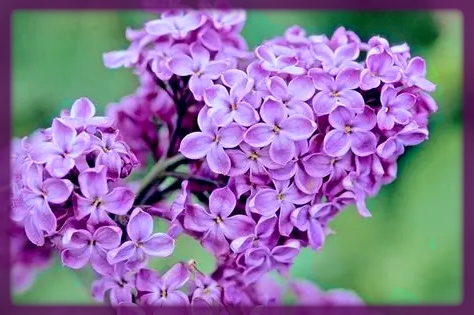
May smells fresh and new and clean and pure.  May brings the purple and white lilacs that bloom for a few short weeks, enveloping the spring air with perfume.  As kids, my friends and I would pluck blossoms and suck their nectar; or so we thought.  We just wanted to be filled inside with May’s loveliest flower.  But by high school, I dropped the weird ritual and stuck with just breathing in the flowers’ delicate fragrance.

Some cultures consider lilacs to represent strong people.  Some believe it to be the flower of love.  It reminds me of my grandma, because the lilac was her favorite flower, as is mine.

Although I liked the somewhat rare while lilac bushes, I was absolutely enchanted by that purple hue of the blossoms that ran from palest amethyst to deepest royal purple.  For a few years, my sister and I even had our bedroom painted lilac.  On gloomy, sunless days the walls slipped toward grey, but when the sun poured in, the whole room seemed to brighten into pastel purple.  For Easter, in my thirteenth year, I wore a lilac chiffon dress with white polka dots, tiny pleats, and a soft lettuce hem.  My school folders, notebooks, and a Bic® pen I owned boasted purple ink, too.  It was the color that threaded through my days, so constant that I hardly noticed it.

Every place where I lived around the country, lilacs were a reality of springtime.  In fact, I lived in a town once where it seemed that everyone had at least one lilac shrub in their yard.  The entire town smelled of that pretty fragrance for weeks!

May is a special month for me, and when I catch a whiff of that springtime perfume, I can still remember burying my face in a perfumed cloud of lilac blossoms.  The memories will remain enduring, and they will envelop me, as only the most beautiful of spring flowers can do.

In the door-yard fronting an old farm-house, near the white-wash’d palings,
Stands the lilac bush, tall-growing, with heart-shaped leaves of rich green,
With many a pointed blossom, rising, delicate, with the perfume strong I love,
With every leaf a miracle……and from this bush in the door-yard,
With delicate-color’d blossoms, and heart-shaped leaves of rich green,
A sprig, with its flower, I break.

—Walt Whitman, “When Lilacs Last in the Door-yard Bloom’d,” 1865.


Wigged Out.

At dinner the other evening at the country club, we sat at a table at the back of the restaurant, nestled in a cozy alcove dimly lit by a warm, flickering candle in a glass votive.  Our wine glasses of glimmered in the low light.  The clinking of silverware and the soft hum of chatter filled the air, punctuated by bursts of laughter from a boisterous group near the bar.

Across from us, a couple sat at the immediate table opposite ours.  They immediately drew my attention with their striking contrast.  She was a petite, frail-looking woman, her presence almost ephemeral, yet undeniably elegant.  Her baggy, sequined blouse sparkled faintly under the muted light, a deep emerald green that complemented the intricate plastic pearls cascading down her neck.  Her white pants, cut high to mid-calf, were snug and showed off her caboose.  Every gesture of hers was deliberate, placing her napkin, adjusting her sleek clutch, moving her wine glass, as though she were orchestrating a performance of refinement.

Across from her sat the undeniable foil to her practiced image.  He was a large man, his frame spilling over the edges of the overstuffed dining chair.  His attire was an amusing affront to hers: a pair of sagging khaki shorts, socks with sandals, and a faded, nondescript polo shirt, the type that might have been gray once but had since resigned itself to a black, lavender, taupe ambiguity.  His bulbous nose was faintly red, matching the ruddiness of his face.

But the pièce de resistance became the highlight of the evening.   It was his hair.  His hair—or rather, what aspired to be his hair was . . .  “different.”  A Just for Men “Darkest Red Brown” masterpiece of a wig was perched atop his head, so incongruous with the rest of his appearance it felt like a punchline to a joke only he didn’t quite get.  The thick, wavy wig seemed precarious, as if it might slide off at the slightest provocation.  It sat too high, too perfect, too ruddy-brown and defying both gravity and reason.

He leaned back in his chair with an air of self-satisfaction, plucking at a breadstick while his lady friend sipped delicately from a wine glass.  They exchanged sporadic words, her responses curt and his booming laugh echoing through the restaurant, prompting raised eyebrows and glares from nearby diners.

They were a spectacle, a living contradiction, a joke, an editorial cartoon.  The woman seemed to be holding onto a bygone era of sophistication, while the man seemed content to bulldoze through it, unbothered by appearances or subtlety.  Yet, there was something oddly appealing about them with a mystery to unravel, a story hidden beneath the surface of their mismatched personas.


The Darkness of the World.

The world is messed up.

If you are paying even the tiniest bit of attention to what’s going on in the world, you might just finally realize that this world is more evil than you would ever imagine, and with vastly complicit help not only from political leaders, but also from the average populace.

I’m sometimes surprised at how jaded I’ve become.  As a young idealist way back in the old days, I had all the optimistic and positive outlooks anyone could have.  That’s saying a lot.  Last year, with a new President in office, I barely delved deep into the current events.  I had it in my mind that he was the same as he was in his first term, so what was there to worry about?  This year began just as pacific for me, until February 28 with the war, and since then, well, you know how nutty everything has become.  Or has it?

My best friend mentioned to me that he noticed that this President wasn’t the same, and maybe so since last fall.  That’s when I took a better look and realized he was on to something.  Yes, he certainly is not the guy we voted for.  We were all duped.

People in general have changed, and vastly so since 2020.  It seems that people have such ease in lying right to your face.  They’re ruder.  They even seem to be lazier.  None of it is good.

The Church isn’t the Church I grew up in.  It’s now the Synodal Church.  The true Roman Catholic Church exists, but one must diligently look for it in other places.  I question the current Pope in the form of Robert Prevost, because what he teaches is, well, all over the place with little consistency for Roman Catholicism.

Nevertheless, I think, the longer a person is on this Earth and seriously pays attention to the idiocy that seems to accelerate by the hour, just about anyone could get pretty jaded.  That’s why I am working towards being in the world, but not OF this world.  It’s sometimes a struggle, because I have it in my head that I need to know what’s going on in the world now, for instance, when the bomb is going to be dropped.  Conversely, isn’t it better to not know, and just be spiritually ready for it exploding at any minute?  Yeah, probably.

The moral disorder in our world is far more profound than the everyday vapid scandals people argue about.  It extends beyond routine political dishonesty and the familiar patterns of institutional failures.  What we are now being confronted with instead are deeper, more sinister forms of corruption; systems of exploitation and abuse that flourish in secrecy and rely on the complacency of the very structures meant to safeguard the vulnerable.  These forces are not isolated or accidental; they are organized, persistent, and woven through the generations from the beginning of time.  Their influence reaches into the institutions that shape public life: government, law, media, entertainment, finance, sports, religious establishments, et al.  This is perhaps why meaningful accountability rarely materializes.  The problem is not that the system has malfunctioned; the problem is that the system, as it currently operates, protects the very darkness it should be exposing.  The world is operating exactly how it’s supposed to, with all the evil engrained in it.

Drain the swamp?  Catchy little slogan, that is.  Instead of draining, the loudest mouths just went ahead and joined the swamp.  Why not?  It’s profitable, and in so many ways, too.

It is naïve to think that the ordinary general public will rise to meet these challenges.  Sure, it’s a nice thought that people will wake up and fight for a successful end to malevolence, but in reality, most people, overwhelmed by the pace of modern life and the cozy comfort of laziness and apathy, have settled into becoming passive observers rather than active participants.  Assuredly, outrage flares briefly online with an angry post typed from behind the keyboard, a click of a shared headline, a momentary surge of indignation, but only to retreat into familiar routines.  But when the moment any public criticism touches celebrities or political figures, the reaction is even more predictable: people defend the evil and/or the evil doer or just shut down and move on to something insipid and vapid, which is usually their comfort zone.  Their attachment to public figures functions as modern idolatry, a sick and macabre loyalty that overrides discernment and sensibility.  Many people will defend entertainers, influencers, government notables, popes and televangelists, and other public personalities despite recurring scandals, unanswered questions, weird speeches from pulpits, and patterns of troubling associations.  For them to confront those realities would require them to acknowledge that their long‑held assumptions were misplaced, that trust was given too freely, and that the narratives shaping their lives were not as benevolent as they believed.  For many, that admission is too costly; therefore, comfort becomes preferable to clarity, and distraction becomes easier than responsibility.

There is also a deeper layer of wrongdoing that most people cannot bear to confront.  Beneath the surface of public life exist networks, institutions, and hidden spaces where exploitation thrives, albeit hidden.  These are not the sensationalized fantasies people dismiss, but the quieter, more pervasive forms of abuse and corruption that flourish when shielded from scrutiny.  The very idea of such concealed systems unsettles people, not only because of the moral horror they imply, but because acknowledging them would require reconsidering the trust they place in the social structure.  This is why so few bother to investigate further.  Once one begins to see the depth of institutional rot and mold, it becomes impossible to return to the comfort of ignorance; yet many people would rather stay in their pretty little cocoons and not be bothered.  Peel me another grape, Daphne.

Is the present moment an actual “awakening?”  That’s hard to say, but even if that is true, it is an uneven one.  Most people struggle to sustain attention in a world engineered for constant distraction.  A new crisis, a new headline, a new spectacle appears, and public focus instantly resets.  The duplicitous news stories change faster than the weather in Chicago.  Faster, faster Pussycat, whip up the chaos!  Whip it up good!   Chaos and confusion, to and fro.

Outrage becomes episodic rather than transformative.  The average citizen does not demand accountability, structural reform, or transparency; instead, they drift back into the familiar rhythms of daily life.  They continue to support the very systems they criticize, through consumption, through compliance, through lazy habits.  In this sense, the problem is not merely institutional corruption but a culture that has grown accustomed to passivity, comfort, and distraction, even in the face of profound moral failure.

The individuals who perpetuate profound harm are not merely “troubled;” they embody a level of moral corruption that defies explanation.  Their actions reveal a conscience that has been systematically eroded, a capacity for empathy that appears extinguished.  Yet, they move through public life with practiced ease— smiling for cameras, delivering speeches, presenting themselves as benefactors, all the while concealing the ethical void that enables their behavior.  This dissonance between public image and private reality is precisely what allows such corruption to persist.

Yet these systems endure not only because of those who exploit them, but because of the collective willingness to look away.  As long as society continues to fund, celebrate, and unquestioningly trust the institutions and figures who benefit from the status quo, little to nothing will ever change.  Evil does not thrive simply because it is powerful; it thrives because good people convince themselves it is safer not to see it.  It’s so easy to play the poor put upon ostrich and bury one’s head in the sand.  The refusal to confront uncomfortable truths becomes, in effect, a form of approval and permission.

Cognitive dissonance is real, but far more often, it’s more of the slow erosion caused by apathy, constant confusion, and the relentless flood of information, outrage, and accusation.  When every voice demands attention and every headline contradicts the last, people slip into a kind of mental fog — not because they’re incapable of thinking, but because they’re exhausted by the effort and they would rather take the easy way.  And in that dazed state, many retreat to what feels familiar.  They worship their idols.  They cling to the idols that reflect their preferred illusions, the figures who reinforce their false beliefs and offer the comfort of never having to question anything at all.

The world is very messed up.

 

Money and the Shape of Life.

Lately I’ve been returning to and thinking about topics I hadn’t examined in a while, and one of them is money, how it shaped my choices, how it ordered my days, and how quietly it became a measure of my worth without my ever intending it.

There was a long stretch when money and job position sat at the center of my work life.  I was always looking toward the next promotion, the next pay step increase, the bonus, the next annual bump in my grade level, the next cost‑of‑living increase.  Each milestone felt like progress, like proof that I was moving forward and being successful (whatever that was).  And overtime?  I never turned it down.  It was money in my pocket, yes, but it was also work experience to add another line on the résumé, another rung on the ladder of upward mobility in middle management.

And then came the question of retirement.  The more I earned and the higher I climbed, the more secure my future seemed.  I’ve always belonged to the “Waste Not, Want Not” tribe, careful, frugal, planning.  I was planning my retirement since my first full-time job after graduating from school.  It felt responsible to think about the long game, to build a cushion, to prepare for the day when work would no longer be on my daily schedule.

By most measures, I did well in the career jungle.  I worked hard, advanced steadily, and positioned myself for a sensible retirement.  But to what end, really?  Some of what I gained came at the cost of things I didn’t even realize I was losing.  I missed moments that could have enriched my life in ways no paycheck ever could.  My eyes were fixed on the horizon with an early retirement, a new chapter, a better future, while the present quietly slipped by.

Money is necessary, of course, since it keeps the lights on and the pantry stocked.  But it was never meant to be the focus; it sort of turned out that way without me paying close attention.  You see, when it becomes the center, even subtly, it distorts the way we see our days and the way we measure our worth.  Looking back, I can see how easily the pursuit of “enough” becomes the pursuit of “more, more, more!” and how quietly that pursuit can crowd out the very things that make a life well lived.

Would a very fat bank account make my life easier?  I’m sure it would, but to what extent?  Yet in the reality of life, I have just what I need to live.  Much more, and it would be living an unnecessarily extravagant and artificial life.

In the end, money can support a life and our Earthly needs, but it cannot give one satisfactory meaning.  What endures is the virtue we cultivate, the charity we extend, the relationships we tend, and the gratitude we carry for the gifts already placed in our hands.  When we let money take up more space than it deserves, the spiritual cost is subtle but real: our attention drifts, our desires narrow, and our hearts grow less free.  But when we return to gratitude and right order, we remember that a well‑lived life is measured not by how much money we have in the bank, but by what we become.

When we allow money to become our quiet master, the emotional cost is real: our hearts grow divided, we become conceited, our freedom narrows, and we begin to measure ourselves by standards that have nothing to do with building positive relationships or redemption.  Yet when we push away secularism and return to true gratitude, humility, and order, we remember that a life well lived is judged not by earnings or advancement, but by a fidelity to what matters for all of eternity.


Smoke, Scrape, Yell, Repeat.

A Lesson Neighbor Consideration.

After writing “The Sheriff of Decibels,” regarding the whole “your TV is too loud” saga with Mr. Wigg, the neighbor who might have been hearing phantom sounds, I thought I had earned a brief intermission in the neighborhood drama, but then it reminded me of one of the downstairs neighbors I had once, and those thoughts led to me think of a whole different angle.  Life in a condominium is basically a rotating cast of social challenges, and the next act began downstairs.

I lived in a condominium where one of my downstairs neighbors used her balcony like it was her personal broadcasting studio.  Whenever she had company, the visitors were always on the sidewalk below.  Their conversations rose straight up.  I didn’t even have to try to overhear; the dialogue arrived fully formed, projected upward with the confidence of someone who believed the entire building was her audience.  If she ever decided to start a podcast, she wouldn’t need equipment.  She already had the lungs for it.

Another neighbor was forever loud on her cell phone.  One afternoon, I heard her give out her bank account number, a passcode, and the balance.  Wow.

Then there’s the patio furniture.  There is a neighbor who, every time she shifts a chair on her balcony, it sounds like she’s dragging a cast-iron park bench across a stone floor.  I’ve heard less noise from actual construction sites.

There was the cigarette smoke from a cheap brand yet another neighbor probably bought by the truckload.  It drifted upward in slow, dramatic spirals, and somehow it slipped into my condo like it had a key.  One moment I’m enjoying fresh air; the next, my living room and kitchen smelled like a casino buffet circa 1960.  It wasn’t ideal, but I learned to adapt since the odor didn’t last more than a half hour or so.

But here’s the important part: I didn’t complain.  Not ever.  Not a text, not a note, not even a pointed throat-clear over the balcony railing.  Why?  Because this was life in a building full of people.  They talked loudly.  They scraped furniture.  They smoked.  They lived.  And unless someone was hosting a demolition derby in their living room, I tolerated the occasional disturbances.

Besides, after the Sheriff of Decibels dealings, I’ve developed a new appreciation for not becoming That Neighbor.  If I ever feel tempted to pick up the phone and lodge a complaint, I remember how it feels to be scolded for noises that may or may not exist.  It’s an excellent deterrent.

So, I let the balcony monologues rise, let the furniture screech across the concrete, let the cigarette smoke drift out and upward like a weather pattern.  I breathed, I adjusted, I moved on.  Because in the grand, chaotic symphony of condo living, sometimes the most intelligent thing you can do is simply not add your own instrument to the noise.

I just laughed it all off.


Illusion and Theater.

I try, as a matter of personal discipline, not to immerse myself in the daily torrent of headlines.  The modern news cycle is a relentless machine—loud, urgent, and yet, it’s strangely empty.  Nevertheless, every so often, despite my best intentions, a headline catches my eye, and I allow myself to get sucked in.  It pulls me in, not because I trust it, but because I’m curious about what new Oscar-worthy performance is unfolding on the world’s stage.

What I notice, repeatedly, is that what passes for “news” rarely resembles anything real.  It feels crafted, curated, sculpted, and arranged with theatrical precision.  The stories are presented as truth, but the tone is too polished, the timing too convenient, the narrative too tidy.  It’s as though we’re being handed a script rather than a window into reality.

And beneath that obvious script lies a deeper question: What is actually happening behind the scenes?

To explore that question, we must look at the four forces shaping our perception: illusion, distraction, power, and the quiet, stubborn search for truth.

I. Illusion is the first layer—the iridescent surface that makes everything appear coherent and trustworthy. We grow up believing that the world is presented to us honestly. School textbooks, official statements, historical accounts— they all arrive with the authority of certitude.  We memorize dates, names, and events as though they are fixed points in time and that’s all that matters.

But the passing of years and paying close attention has a way of peeling back the veneer.  The more we learn, the more we realize how much of our education was simplified, sanitized, or strategically framed.  History is not a neutral record; it is a purposely fashioned narrative.  Once you recognize that, the illusion begins to crack.

The news, too, operates on illusion.  It offers the appearance of transparency while carefully shaping what we see and how we interpret it.  The lighting is perfect, the talking points rehearsed, the outrage calibrated just so.  It is a performance designed to feel spontaneous and honest.

Illusion is powerful because it is comforting.  It gives us the sense that the world is orderly, that someone is in control, that events follow a predictable script.  But comfort is not the same as truth.

II. Distraction is the orchestra, if illusion is the stagecraft. The modern world is engineered for distraction. Headlines flash, notifications ping, commentary multiplies.  Every story is framed as urgent, every disagreement amplified, every trivial event inflated into a crisis.  We, as the audience, are encouraged to react, not reflect.  Distraction keeps us busy.  It keeps us emotional.  It keeps us from asking deeper questions.  It’s not that the stories are always false; it’s that they are strategically incomplete.  They direct our attention toward the sensational and away from the structural.  They keep us fixated on personalities instead of systems, scandals instead of patterns, noise instead of meaning.

Distraction is not accidental.  It is a tool of control.  A distracted public is a manageable public—too overwhelmed to notice what truly matters.

III. Behind illusion and distraction lies the engine that drives them: power.  Power prefers the shadows.  It prefers complexity, secrecy, and silence.  It prefers a public that is too divided, too exhausted, or too entertained to scrutinize its actions.

The real story of any era is not the headlines; it is the decisions made quietly, behind closed doors, by people whose names we rarely hear.  The world is shaped not by the performances we watch, but by the negotiations, alliances, and calculations that happen backstage.

We were taught in our schools that power is straightforward: governments govern, leaders lead, institutions protect the public good.  But the older we get, the more we see how naïve it was believing those views.  Power is rarely transparent.  It is rarely benevolent.  And it is almost never accountable unless it’s forced to be.

Subsequently, we are left with the unsettling question: What are the kings doing—and what are they hiding?  The answer is not handed to us, so we must seek it ourselves.

IV. Truth becomes a personal responsibility in a world of illusion, distraction, and hidden power.  Truth must be pursued.  It requires discernment, patience, and a willingness to question the narratives we were raised to accept.  It requires stepping back from the clamor long enough to see the patterns beneath it.  It requires humility; the recognition that certainty is often a trap.

But the search for truth is also liberating.  When illusion cracks, clarity emerges.  When distraction loses its grip, attention sharpens.  When power is questioned, accountability becomes possible.  And perhaps this is the quiet rebellion available to each of us: to stop being extras in someone else’s production and instead become vocal observers; aware and unwilling to be fooled.

All the world is a stage… but we do not have to play the part we are assigned.


Live Well and Worthily.

Life is short, and it is meant to be lived well.  Wouldn’t you rather pour your energy into living it with virtue, steadiness, and joy than spend your days wrestling with every distraction that tries to muddle it?

Life is much too short to . . .

. . . waste time.

. . . not read the Bible.

. . . read tasteless books/magazines.

. . . be subjected to vulgar language.

. . . be exposed to disparaging gossip.

. . . argue with strangers on the Internet.

. . . be around people with no sense of humor.

. . . be around combative and negative people.

. . . watch a program that turns out to be vapid.

. . . listen to the “news” when there isn’t any news.

. . . not crack open a book written by or about a saint.

. . . be entertained by raunchy “entertainers” and “artists.”

. . . put up with the rat-a-tat-tat of unimportant intrusions.

Life— wouldn’t you rather live it well and virtuous than fight what’s interfering with it?


Website Built with WordPress.com.

Up ↑