
Cluttered and Pressured Speech, Distractions, and Titillating Television
Earlier this week my best friend and I went out for lunch. We stopped at a new-to-us casual restaurant in a shopping mall that boasted hamburgers and pizza on their colorful neon sign. On the face of it, it sounded good for what time we had, and we parked the car and headed to the door.
As soon as we pulled the door open and stepped inside, loud rock and roll music and chattering assaulted my ears. Granted, it wasn’t as loud as that Texas greasy spoon chain, but it was still along the lines of noise-to-hinder-your-table-conversation commotion. I let it go, didn’t dwell on it, and soon we were seated by the hostess.
A pleasant and bouncy young waitress soon appeared and took our drink orders. Meanwhile, we took a menu to read. I barely opened the lunch menu section when the waitress returned with our drinks. That is when the fun began.
Waitress: Have you been here before?
Us: No; first time.
Waitress: Well, let me tell you what’s on our menu, and if I talk too fast, let me know.
Fair enough, I thought. Best Friend and I nodded. And off to the races went the waitress.
She spent the next four to five minutes reading the menu, flipping the sections back and forth and pointing to this and that. Did she talk too fast? Yes. All I heard was “hamburgers,” “specials,” “order,” and a lot of mumbling.
I glanced across the table. Best friend was nodding and looking at the menu to where the waitress pointed— here, there, next page, back to the first section, and back to the middle. It was a flurry of menu-flipping, jaw flapping, and too-much background noise. It felt like a distraction.
When she was done, she asked, “So, do you know what you want?”
I leaned forward into my menu, and said, “I haven’t looked at the menu yet,” and I suggested Best Friend order before me while I collected my thoughts. “Habañero Hamburger” was what I heard, so I ordered it, too, since it sounded good.
Waitress, to me: Do you want mayonnaise, tomato, lettuce on it? I don’t like tomato on mine because I don’t like it. It makes the hamburger too mushy for me.”
Me: I’ll eat it, so I want the tomato.”
I thought to myself, It’s my hamburger, I’m not ordering it for her, and I don’t care what she likes on her hamburger. I like tomatoes on nearly every sandwich.
When the waitress cheerfully left to take our orders to the kitchen, I mentioned to best Friend this: “Why bother giving patrons a menu, when the waitress reads it for them? And what’s with the speed-talking? It’s like she’s the daughter of the FedEx commercial guy that rattled off the ad at lightning speed. I only heard three words: specials, hamburgers, and order.”
When I feel like I’m pushed with fast talking and overly grand hand movements, I shut down. It’s exhausting for me, since I prefer calm and time for discernment, not this Slam! Bam! pitch. I looked around the restaurant. It was early and not crowded at all. There wasn’t a line snaking around the building. There were plenty of empty tables and booths, so the Slam! Bam! pitch had nothing to do with patrons waiting for tables. I think it’s the attitude of the management.
While we were waiting for our order, I looked up at the twelve television screens hanging on the perimeter of the dining room. Each was turned to a different channel, all were busy with too much action: sports, music videos, game shows, comedy acts. The music videos were an assault to my eyes, with thinly clad, nearly naked females suggestively bouncing hither and tither with half naked backup crews performing grossly suggestive sexual movements in tandem with the “singer.”
It’s not what anyone should want to see at lunchtime, or any time of day or night. I don’t. It’s the devil’s little helpers assaulting the public under the guise of “music,” and lousy music at that. You know it, and I know it. But those scenes try mightily to grab your attention and attempt to send your mind to impure thoughts and hold your eyes on the screen.
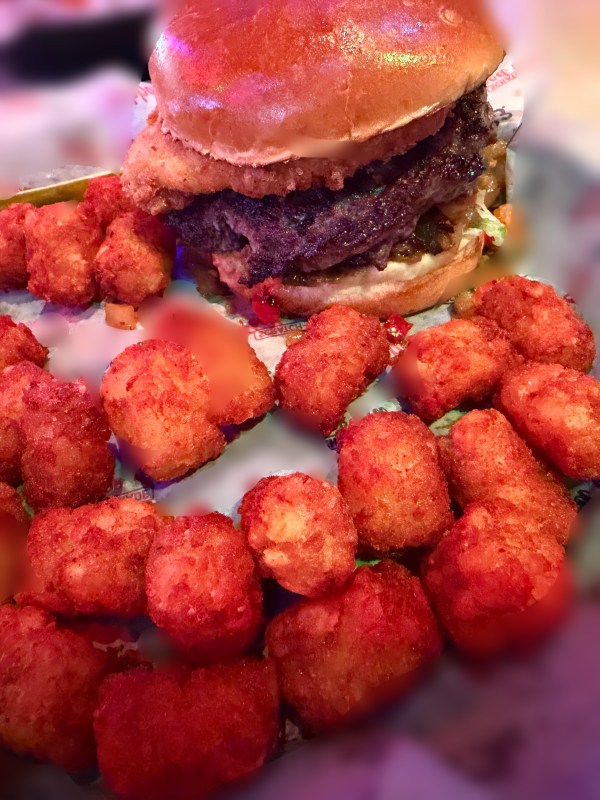
The meal itself was hot, average, and appetizing. When you’re hungry, nearly any food hits the spot. I was a little disappointed that the habañero pepper sauce was only on a quarter corner of the meat; I expected it to be spread across the full patty. It turned out that I only ate the meat and a few tater tots, which I wound up taking most of them home in a Styrofoam® box. I planned them as leftovers with that night’s ham sandwich. The hamburger bun was ginormous for me, but in hindsight, I should have also taken it home to use later on a lunchmeat sandwich.
I understand that it was most likely the job of the waitress to read the menu to patrons, but I find it to be not only gravely distracting, but pushy, too. It’s called “pressured speech,” wherein the speaker talks and talks about the product without giving the patron or customer time to read the menu on his own and make a decision. What I am used to is that a patron peruses the menu, and if there is a question, the waiter answers it – not this full reading of every menu item.
Nevertheless, perhaps one lesson I learned is that when going to a new-to-me restaurant and when I’m asked if this is my first time, a little fib saying “no” might alleviate the full menu-reading by the waitress and the much-too-much-information I don’t need to order a meal. Yet, fibbing isn’t right, so I’ll continue to be honest with people and just bear the millstone.
Employees have their jobs to do. I’m not obligated to return with my patronage, either.