The Sheriff of Decibels.

I once lived in a high-rise condominium where everyone kept to himself, and all was peachy with the world.  But there was one night when I received a phone call from a neighbor, informing me once again that my television was on “too loud” and he can’t sleep.  I was watching an old movie, as I usually did in the early evenings if I stayed home.  This was a recurring performance on his part, a kind of neighborhood opera in which he played both the aggrieved victim and the self-appointed Sheriff of Decibels.  At that point, I was starting to wonder whether the sound was actually carrying or whether my neighbor simply enjoyed the thrill of a good complaint because the room where my television is did not butt up against his bedroom, but against his butler’s pantry.

Here’s the twist: I could hear his television, too.  Talk shows, game shows, dramatic monologues, the whole cinematic buffet.  And yet I’ve never felt compelled to call him and deliver a noise citation.  I’d assume he was just… living.  Watching things.  Being a person in a building full of other people doing what people do to live.  It’s part of the deal when you choose communal living over a cabin in the woods on ten acres.

Still, every time my phone lit up with his name on the screen, I rolled my eyes.  At that time of evening, it could not be a friendly hello.  It’s always a report, as if he was monitoring my condo with a sound meter and a clipboard.

I played with the idea that conducting an experiment or two.  I thought of turning down the volume to a whisper—barely audible even to me—and wait.  Would my phone ring?  I don’t know, but I was willing to bet a dime to a donut that he was hearing phantom noises, or he had superhuman hearing, or perhaps the echoes of his own television bounced around his condo like a boomerang.

There’s a special kind of fatigue that comes from dealing with neighbors who are both hypersensitive and oblivious to their own habits.  It’s like being scolded by someone about your manners when they are chewing food and smacking loudly with their mouth open.  You want to point it out, but you know it won’t land.

So, I’ve reached a conclusion: either my television had mystical projection abilities, or my neighbor developed a hobby of policing imaginary disturbances.  I continued living my life at a reasonable volume.

And honestly, at that point, the only thing louder than my television was that special kind of comedy.  Personally, I think he had his wig on too tight.

The Gentle Art of Wholesome Reading.

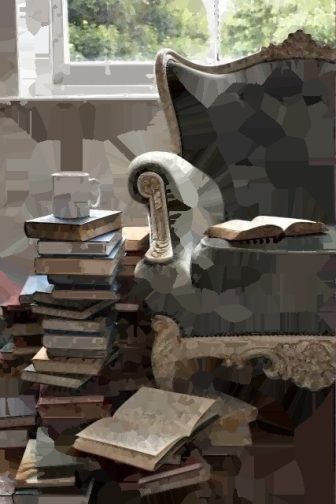
There is a particular enjoyment in reading good, wholesome books— a joy that feels almost old‑fashioned in the best possible way.  These are the books that don’t shout for our attention or compete with the noise of the world because they simply open a door and invite us into a place where I can breathe.

Wholesome books remind us that goodness is not naïve, that beauty is not fragile, good language is a delight, and that truth can be spoken without cynicism.  They offer characters who struggle honestly, worlds that lift rather than darken, and stories that leave us a little more human than they found us.  In a culture that often rewards vulgarity, shock, and spectacle, these books feel like a quiet rebellion.

There is also a deep restfulness in them. When we read something good and clean and true, our minds unclench.  We remember that gentleness is not weakness and that hope is not foolish.  Even a simple story told with sincerity can become a small refuge.

And perhaps that is the greatest joy of wholesome reading: it forms us.  It shapes our imagination toward the good.  It teaches us to look for light, even in ordinary places.  It reminds us that the world is still full of things worth loving.

A good book doesn’t just entertain; it nourishes us, and in a time when so much reading leaves us scattered or weary, finding a book that restores us is its own quiet ways.

So far this year, I have read the following good books.  They are in the order of publication year.

Seeking the Heart of Christ by Saint Claude La Colombière (1680)

Ole Mammy’s Torment by Anne Fellows Johnston (1897)

Light and Peace: Instructions for Devout Souls to Dispel Their Doubts and Allay Their Fears by Carlo Guiseppi Quadrupani (1980)

The Wisdom of Fulton Sheen: 365 Days of Inspiration (2020)


Finding Grace and Renewal.

Remember thou art dust,

And unto dust thou shalt return.

As you receive your ashes this year, pause for a moment. Let that simple cross traced upon your forehead remind you that our days are fleeting, yet the mercy of God endures forever.  These ashes echo the ancient words of Scripture—“Remember that thou art dust, and unto dust thou shalt return”—not to burden us with fear, but to awaken us to grace.

This Lent, may the ashes draw you away from despair and toward the hope promised in Christ; away from shame and into the healing tenderness of His forgiveness; away from mere reflection and into true conversion of heart.

For the ashes matter not for what they are, but for what they call us to become: sons and daughters who walk in humility, disciples who practice mercy, and souls renewed in the love of the Crucified and Risen Lord.

I will be posting my essays throughout Lent; most of them are pre-written so that I can concentrate on this holy season.


Are Our Lives Truly Well-Lived?

A lifetime spent chasing approval, possessions, and the noise of the world gradually drifts away from its own center.  From an early age, we learn to shape ourselves around external expectations, as if our worth could be measured by admiration, status, awards, or the objects we manage to collect, and the amount of money we amass.  Yet these pursuits, however dazzling in the moment, dissolve quickly.  What remains is the quiet sense that we have been living outward rather than inward – living as part of the world, rather than in it.

Philosophers across centuries have warned of this drift.  They remind us that the self becomes fragmented when it is scattered among too many desires, especially those desires that are not truly our own and those that make us look “better” to our family and friends.  Simplicity, then, is not merely a lifestyle but a discipline.  It is the art of refusing to be ruled by the shifting opinions of others or by the endless accumulation of things that promise satisfaction but deliver only distraction.

To live a life well done is not one that has a swanky mansion, a jet set lifestyle, and a fat bank account.  It is, rather, one that turns toward what endures: clarity of mind, steadiness of good character, faith, humbleness, and the courage to act from one’s deepest convictions.  Approval fades, possessions decay, and the world’s applause is notoriously fickle and false.  But integrity and true faith — quiet, unadorned, and often unnoticed — has a way of anchoring the soul.  It allows us to move through life with a sense of coherence rather than fragmentation.

When we stop performing for the world and begin listening to our inner voice that asks for honesty, restraint, and purpose, something positively shifts.  The anxieties that once governed our choices loosen their grip.  We begin to see that the real measure of a life is not what we accumulate but what we cultivate: meekness, compassion, wisdom, and a mind unburdened by the distractions of excess.

This is the freedom available to anyone willing to step away from the noise and chaos.  It is the freedom to walk lightly, to choose meaning over clutter, and to rest in the quiet assurance that a life of depth will always outshine a life of accumulation.

Peace,

Susan Marie Molloy


The Quiet Freedom of Downsizing.

To live in the world does not mean to be of the world.

Decluttering for my downsize from a large and charming house into a small and pretty condominium has been very freeing— not in a dramatic or sentimental way, but in the simple, practical sense of watching my home become cozier, easier to live in, simpler, and practical.

Before the move, as I sorted through closets, desk drawers, and the pantry, I realized how much space was quietly being taken up by things I no longer use, need, or even notice.  Letting them go has lifted a weight I didn’t realize I was carrying.  The donations to a local thrift store and selling some of the unnecessaries on eBay were enormous: bed, dressers, couches, wing-back chairs, kitchen items, extra knitting needles and crochet hooks, and clothes.  Each shelf cleared, each drawer emptied, every excess piece of furniture donated, each bag of unwanted clothes brought a small but actual sense of relief.  I felt lighter, and the burden is gone!

Another part of downsizing was unsubscribing to businesses I no longer have a need.  It reduced my e-mails, and it also inspired me to get a new password book and reorganize my passwords and account numbers to necessary sources.

Downsizing has also made daily life more manageable.  With fewer belongings, there’s less to clean, less to organize, less to keep track of, less to clutter shelves, closets and cabinets.  Surfaces stay clear longer.  Rooms breathe.  I can find what I need without becoming disgusted at the overflow.  Even the atmosphere feels different— calmer, less crowded, minimal, attractive.  It’s amazing how much peace comes from simply having less.  The home begins to work with you instead of against you.

One of the other positives, too, was that the moving truck wasn’t stuffed with “things.”  Everything that was loaded up was exactly what was needed in the new place.  No “maybes,” no “I’ll think about it later.”

Now, after settling in the new place, I decide that when any piece of clothing becomes too worn out to wear, it gets thrown out and its replacement is questionable.  I don’t need seven pairs of shoes or a dozen dresses.  All that cheesy costume jewelry?  Gone.  Purses?  Three are enough.  A plastic serving spoon breaks, and I don’t replace it since I have wooden ones to use.  Now all of the replacements are up for discussion, and rightly so.

This process has reminded me that a peaceful home isn’t created all at once; it’s built through small, steady decisions.  Choosing what truly serves your life today.  Releasing what belongs to the past.  Making room for order, beauty, and ease.  Downsizing has become a way of shaping my home into a place that supports the life I’m living now— not the lavish life I lived years ago, and not the life I imagined I might need to prepare for someday.

If anything, this move has taught me that simplicity is practical.  It’s not about perfection or minimalism for its own sake.  It’s about creating a home that feels manageable, welcoming, and aligned right.  And in that sense, the freedom I’ve found is not abstract at all— it’s woven into the daily rhythm of living in a space that finally feels like it fits right.

As I continue to live in the world without being of the world, I find myself being better-off and having more time to pray and read good, clean, and educational material.

You would be surprised at how little a person really needs to function in this life.

Peace,

Susan Marie Molloy

Website Built with WordPress.com.

Up ↑