The Reeking Lockbox and a Pause.

A Lesson in Odors and Moving Down the Road.

I opened the door to the hallway as I was leaving my condominium, and my nose was hit with an acrid, pungent, almost-burning-rubber stench.  The only new thing in the common area was a lockbox that was put on the door of a unit that was just put on the market.  I walked over to the lockbox, leaned over and took a whiff.  Yes, sure enough, that was the odorous stench!  The lockbox was covered in a rubber casing, so you can imagine the horrific burning rubber smell!

It made me feel queasy to the point of almost retching.  It got to a point where I could faintly smell it in my condominium, too.


This concludes my essays on former neighborhoods in which I lived, where neighbors, property managers, and situations were quirky, strange, and sometimes laughable.  My essays will henceforth focus more on simple living, reflections, lessons for a pious life, and humor.  My essays will resume here on Thursday, October 1, 2026.


The Sage Pointe Nine – Too Many Toys for the Toybox

A Lesson on Gluttony.

Previously, I wrote about the Weede family and their fusty skunk hijinx, and that story kept on expanding over time, not only with the odors, but with their possessions, too.

To recap:  In one apartment lived the matronly mother and one of her grown sons.  Directly across the hall lived her daughter, her husband, and their passel of kids.  Then one hot mid-summer day, the Weede family expanded their population in the Sage Pointe complex with the matron’s other son, his girlfriend, and their baby who all moved in with her.  That made a total of nine Weedes in two apartments: five people in Mamma Weede’s place, and four in the other.

One of the messes in the common areas that pointed to the Weede family was the indoor pool area.  It became messier with a sickening overload of beach balls, floats, and tiny plastic toys sitting at the bottom of the pool that they left, as if the pool area was theirs alone.  They wouldn’t clean up their possessions.  Instead, they left their things for other residents to trip over.  Moreover, that family complained a lot when the pool was in repair.  La-di-da.  It even got to a point that they left their pool toys all over the common property, and one beach ball made it to the pond area, and it’s been sitting there for months upon months.  There it is in the lower portion of this photograph, in all its pink and white glory:

In the end, the Weedes’ presence swelled with their toys, tricycles, sand shovels, dolls, and baseball bats that hung like spores in the common areas, tucked around the buildings, in the grass, and by the pool.  They were a reminder that some households don’t just live in a building; they colonize it and make it unpleasant for the other owners who respect neighbors.  Yet, at Sage Pointe, the Weedes were not merely neighbors.  They were an atmosphere of eccentric proportions that took over and conquered.

It’s something to behold when people have so many possessions that they don’t miss them when they are scattered hither and yon.  That’s the clue when gluttony becomes the norm.


The Sage Pointe Nine.

Previously, I wrote about the Weede family and their fusty skunk hijinx, and the story kept on expanding over time.

To recap:  In one apartment lived the matronly mother and one of her grown sons.  Across the hall lived her daughter, her husband, and their two kids.  Then one summer, the Weede family expanded their population in the Sage Pointe complex with the matron’s other son, his girlfriend, and their baby who all moved in with her.  That made a total of nine Weedes in two apartments: five people in Mamma Weede’s place, and four in the other.

With this addition came much more garbage in the dumpster.  Almost overnight, the garbage dumpster was overflowing only a couple of days after the garbage was picked up.  It was hard to say if it was only because of the three-person increase overnight in the building’s population, or not.  Some of the garbage dumped pointed to other people, so it probably was a combination of more people in the building and those other residents who were getting ready to move out (and that’s another story),

But what did point to the Weede family was the indoor pool area.  It got messier and messier with a sickening overload of beach balls, floats, and tiny plastic toys sitting at the bottom of the pool that they left, as if the pool area was theirs alone.  They wouldn’t clean up their possessions, but rather, they left their things for other residents to trip over, and they complained a lot if the pool was in repair.  La-di-da.  It even got to a point that they left their pool toys all over the common property, and one beach ball made it to the pond area:

Although their contributions to the marijuana stench in the building decreased for a while, it eventually returned.  The entire floor in the hallway was an aromatic offering that ranged from “forest‑floor funk” to “burnt tire with herbal aspirations.”  They left the elevator lingering with the aroma of greasy chicken and the tang of old tacos.  Their front doors were like portals to a different dimension, one where the ventilation systems and their filters went to die and rot.

In the end, the Weede clan became less a family and more a weather system that rolled in without warning, reshaped the landscape, and left its own peculiar sediment behind.  Their presence swelled and receded, their odors rose and fell, their toys multiplied like spores in the humid air of the indoor pool.  The areas outside their storerooms got to a point that they looked like a flea market with all the junk, furniture, and other assorted garbage left out.   And though their skunky fog ebbed for a hot minute, it always found its way back, drifting through vents and lingering in the hallways like a reminder that some households don’t just live in a building; they colonize it and make it bad for the other owners who respect neighbors.  Yet, at Sage Pointe, the Weedes were not merely neighbors.  They were an atmosphere of eccentric proportions that took over and conquered.


Hot Tea and Buttered Bread.

A Lesson in Appreciation.

As I stepped onto my terrace and looked across the meadow this morning, a small breeze brought a reminder that was a chill in the air, and 74 degrees Fahrenheit is a chill when the daytime air temperatures have been in the upper 90s!  Last night, a bit of a cold front passed through, along with a heavy thunderstorm, as it sometimes does here.  Now, this morning, I inhaled the fresh air and watched as the rising sun brought the dew on the grass to sparkle and glisten.  The colors of the new sunrise shifted from a pink-apricot sky and settled into a mundane blue grey.  The clouds were just as grey, too.  I wouldn’t be surprised if it rains again later this day.  In the distance, a flock of birds chirped away.  A fresh new day is upon us!

Here we are, mid-summer.  The days are warm, the thunderstorms are strong, and every day is fresh with new life.  I took note that the trees are fully leafed out and green in their full summer regalia.  Even the fields are inviting.  I went back inside just as the breeze kicked up again.

Oh!  There it is!  The timer just went off on the stove.  You see, the bread I’m baking this morning is done.  It’s a pan de mie with oats.  It is a French sandwich bread with a tender crumb and baked in a Pullman load pan.  It’s among the best breads I bake.

It’s now time to bring out the butter and a hot cup of Earl Grey breakfast tea to get my day started!

What is familiar in my world is comfort, just as the changing seasons, jazz, and a slice of hot buttered bread and hot tea are.


Dead Man Dripping.

A Lesson in New Décor, a Bath, Dying, Waterfalls, and Horror.

When I lived at Whispering Oaks Condominiums many years ago, I had a cute place on the first floor.  It had two balconies, a galley kitchen, two bedrooms, two baths, and a combination dining room-living room.  It was small, decorating was easy, and I made it cozy.  All was serene until one Saturday night when the water came down in glistening sheets along the living room wall.  It came not from the condominium above, but from the condominium above that on the top floor.  The water continued flowing down to the garden condominium, below mine.

The owner was at work that evening, since he worked nearby at Marshall Field & Company department store, and he worked a late shift that evening.

Why the water was coming from that unit on the top floor, was anyone’s guess at that point.  That is, until the firemen reached the top-floor unit and found the door locked tight.  It was an ominous quiet, broken only by the sound of relentless water streaming from beneath the doorframe. With a sharp crack, they forced their way in, only to be greeted by the surreal sight of the overflowing bathtub, its porcelain edges barely visible under the torrent.  The man, naked, pale, and motionless, lay slumped against the tub’s curved back, his arm draped on the side of the tub, and a twisted grimace frozen on his lifeless face.  The scene was both tragic and bizarre, a moment frozen in time, where the quiet intimacy of a bath had turned into a macabre tableau.

The body in the bathtub was an older man, the roommate of the owner.  He evidently was drawing his bath while he sat inside the tub, died at some point, and the water kept pouring and pouring from the faucet and over the sides of the tub, throughout that unit and down to the three units below.

When all was said and done, the amount of drywall and painting repairs was enormous for all four condominium units, but insurance helped.  Repair crews swarmed the building in the weeks that followed, wielding industrial dehumidifiers and cutting through warped drywall.  The affected residents exchanged tired smiles in the lobby and hallways, commiserating over the shared ordeal.  The owner of the unit, still reeling from the news of his roommate’s passing, tried to reconcile his grief with the practical nightmare of insurance claims and restoration costs.  Each floor of the building bore its own unique scars from the incident of a soggy imprint of a life, and death, left behind.

Several months after Joe’s live-in boyfriend, Guiseppe, died in the bathtub, another waterfall occurred.  Joe scheduled carpetlayers to remove his old carpeting and install fresh wall-to-wall shag carpeting.  The residents in the general area heard the soft tapping of hammers and thought little of the work being done.  But soon after they saw it.

Water was once again running down their living room walls.  The wall was glistening with the water dripping and flowing down.

Once more, the residents living below Joe ran upstairs to see if it was his crew that caused a small waterfall.  And sure enough, it was.  The carpet layers hit a water pipe in the floor when they were reinstalling new carpet tack along some of the walls.  A hole in the pipe was punctured, and voilà!  The waterfall.

Once again, his insurance had to pay for drywall and painting repairs in the three condominiums units below him that were affected.


 

Threads of Defiance.

A Lesson in Obedience and Conformity.

I lived in a homeowner’s association where wet towels drying on the balcony railings became the norm early on.  It was one hot summer afternoon, as I returned from work, I looked up at my building after parking my car in the lot.  There, colorful and flapping, were Ambrose and Un’iqué’s wet towels.  They clung to the eighth-floor balcony railings, the corners flipping up delicately in the breeze.  Although the colorful terry cloth towels looked pretty on an otherwise mundane beige balcony, the rules of the homeowners’ association forbade anything hanging on those railings.

But Ambrose and Un’iqué did it anyway.  Every Monday, which was wash day, their wet towels would hang until dry.  In the heat of the summer, every time the couple headed to the neighborhood pool, you could bet their beach towels would be draped across the railings after they returned to their apartment.  Over time, the towels became more than an act of defiance; they transformed into a symbol of quiet rebellion.  Neighbors began to notice Ambrose and Un’iqué’s colorful display as a sort of unspoken statement: life, with all its messiness and imperfections, could not be entirely controlled by rules and regulations.  They did it their way.

Of course, it was against the rules, by-laws, and such, but in the interest of so-called community harmony, the board of directors looked away.  It wouldn’t be nice to point out infractions, they’d say.  In reality, they broke rules, too, and it wouldn’t be right for a director on the board to be sent a friendly violation letter.

No matter that, the buildings started to look like New York City’s nineteenth century tenements.  Remember, it wasn’t all about not offending the offenders.

Soon, the monotony of the beige façades was punctuated by a patchwork of drying laundry.  Mrs. Delgado on the third floor hung out her hand-sewn quilts.  The Nguyen family draped their vibrant picnic blankets next to their toddler’s onesies.  Even creaky old Mr. Carmichael, once the staunchest enforcer of the by-laws, let his Hawaiian shirts flutter in the wind on hangers.  No one cared anymore.

The board of directors convened an emergency meeting to address what they called “The Towel Crisis.”  Yet, each time they discussed enforcement, someone brought up the sense of community the colorful fabrics had inspired.  The formerly frosty interactions between neighbors thawed, and people began smiling at each other as they passed through the hallways.

Ambrose and Un’iqué, seeing their small act ripple outward, became minor legends in the community.  And while the buildings may have resembled New York City’s old tenements, there was warmth and vibrancy to them that was cultivated that not even the strictest homeowner’s association rules could suppress.

The heck with rules!


The Flashing Enigma.

A Lesson in Rubbish.

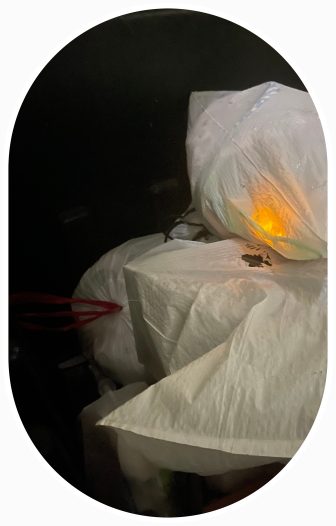
Back in the spring, for seven relentless days and nights, a strange light pulsed from deep inside a solitary garbage bag in the apartment house dumpster.  Two months on, I can almost imagine it is still flashing in a landfill:


A Tart in the Making.

A Lesson in Modesty.

One afternoon a long time ago, when I discovered that the Stankles’ daughter had left her wet “M” on the condominium elevator floor (see my essay, “The Mark of Mordechi”), I also noticed another troubling pattern taking shape.

About a week later, as she walked through the lobby, this twelve‑year‑old was dressed in a way that was startlingly immodest for a child her age.  What shocked me was not merely the barely-there-bikini itself, but the contradiction behind it.  An exposed belly button with floss for bottoms and the top just covering the nips.  That’s it.

Her father is a “preacher” in a community fellowship.  Her mother teaches in a Christian school.  One would expect that parents who publicly live a life of Sunday preaching and Christian schooling would guide their own children toward modesty, dignity, and respect for themselves and others, particularly since it’s all laid out in the Bible.

If these parents claim to follow God’s laws, which includes the call to modesty, why is their daughter being sent into public areas dressed in ways that undermine or ignore those very teachings?

It was hard not to miss the wide disconnect.  The preacher man and his wife presented themselves as righteous leaders in public, yet the example they set within their own household tells a very different story.  They were rude and cold around people when it’s only them without the others, but the moment another Stankle appeared beside them, the transformation was instantaneous.  Suddenly it was All Christian, All the Time: doors held open, cheerful greetings, syrupy small talk, and enough forced sunshine to blind a person.  As a group, they radiated a kind of performative wholesomeness.  Alone, each one reverted to something far less Christian.

It does not come across as practicing what is being preached with a “Glory Halleluiah” on the stage every Sunday and Wednesday.

That is the deeper sorrow of it all; when those who are entrusted with shaping young souls fail to live the very virtues they proclaim, the child becomes the one who bears the confusion.  A home that should be a sanctuary of positive formation instead becomes a place of mixed messages.  I prayed that Maddee grows into a someone who has a clearer understanding of modesty and faith, and that her brother follows the righteous way, too.  But even more, I pray that her parents rediscover the integrity their public roles demand.  For the sake of their daughter, and for the sake of the witness they offer to the rest of us, I hope they all find their way back to the truth they profess and convert.


Twinkie’s Temper Tremors.

A Lesson in Anger and Envy.

Twinkie Terwilliger had all the charisma of a dirty wet dishrag.  He took offense at anything that didn’t cater to his inflated sense of self-worth.  The moment someone failed to shower him with praise, acknowledge his so-called brilliance, or metaphorically place a sparkly golden trophy in his hand for simply being present, the subsequent scene was inevitable.  He couldn’t stand other people holding the limelight or doing something better than he, and his envy got the better of him.  His fragile-as-glass ego shattered into a million pieces, and therein the theatrics began.

His eyes bulged as if they might pop from their sockets, his face flushed a shade of deep red.  His entire body tremblef uncontrollably, reminiscent of someone in the throes of psychogenic tremors.  To the untrained eye, it might have looked like a medical emergency, but those who knew him understood that it was just another of Twink’s infamous tantrums.

As his voice rose, so did the drama around him.  He just had to be always be right, no matter the subject.  Everyone else was wrong in his mind.  He jabbed a trembling finger toward his supposed offenders, the veins in his neck strained with every shouted word, his bald head turned a bright beet red.  “There you go again!” he bellowed, and his voice cracked as if rehearsing for a poorly performed stage play in the junior high thespian club.  The words echoed sharply and accusatory, and it left his targets unsure whether to laugh, apologize, or simply walk away.

At workplace meetings, his fellow meeting-goers were drawn in by the commotion.  Their expressions were a mix of disbelief and thinly veiled amusement, and many were unable to suppress a smirk or guffaw.  Yes, they had seen this performance before, yet it still left them to marvel at the sheer cheekiness of it all.  Moreover, there was a certain dark humor to watch a grown man who’s sixty years old throw a tantrum that rivaled any spoiled toddler in a toy aisle.  Not a meeting went by where he didn’t scream and shout at perceived insults to him.  He also invariably imagined that he was insulted at every turn, for he had a serious paranoia problem.

When he was back in the neighborhood throwing tantrums, he had a personal crusader.  His father, whom everyone called “Papó,” inevitably stepped forward to be Twink’s personal crusader.  He completed the absurd tableau.  Papó nodded solemnly and would then puff out his chest past his beer belly.  His face wore a forced mask of indignation on behalf of his son.  “He’s just passionate,” Papó explained to the gathering, as though this outburst were some misunderstood acts of controlled brilliance.  He, defending his sixty-year-old child as if he were still a little boy on the playground, being teased for wearing a pink elastic eyeglasses retainer on his head!

The crowd would disperse, with knowing glances exchanged and whispers passed among them.  Meanwhile, Twink stood tall once more and basked in his father’s validation, as if he’s won a moral victory that rivaled Napoleon.  The storm would subside, until the next perceived slight against him stirred it anew with his temper tremors.


Website Built with WordPress.com.

Up ↑