Good Friday.


Exploring what it means to live with character, purpose, humor, and quiet distinction in a secular age — through reflections on culture, manners, and the enduring values that shape a well-formed life without toxicity.

I have long known that the most reliable way to lose weight is also the least glamorous: change the way I eat, and do it without powders, liquids, pills, or any of the other gimmicks that promise transformation without effort. They don’t work. Real change comes from willpower, ordinary food, and an honest attitude. These matter more than any trend.
This year, my efforts began even before Lent arrived. A goal of losing eight pounds is losing eight pounds for more energy and just feeling better overall. As January unfolded, I found myself preparing not only my interior life but also my habits. I started cutting down on unnecessary snacking that crept in after supper. Sure, I still indulged in a snack here and there, but it wasn’t gorging myself. I continued my quiet campaign against corn syrup and the sugary additives that hide in so many foods. And I returned to simpler cooking—meals that didn’t need to resemble anything from a fancy restaurant menu. I proved to myself that I can cook anything well, so why do it every day? That should be saved for special occasions. Then I returned to meals that I grew up on that nourished rather than entertained. There was a certain relief in that simplicity.
By the time Ash Wednesday arrived in mid‑February, I wasn’t scrambling to begin anything new. I was simply continuing what had already taken root and ramping it up a bit. The weight began to come off, slowly and steadily, and it still does. But more importantly, the discipline of eating differently began to shape the discipline of living differently.
Attitude is half the work. I stopped letting the noise of the secular world dictate my mood or my focus. I ignored the foolishness that swirl around in headlines and conversations. Instead, I turned my attention toward things that actually strengthen the soul: spiritual reading that lifts and edifies the mind and praying the Rosary with attentive meditation rather than mindless haste. These practices didn’t just support my physical goals—they steadied my interior life.
There is a quiet joy in sacrifice when it is chosen freely and offered with purpose. Lent simply gave me the structure to continue what had already begun: a return to simplicity, a clearer mind, and a heart more anchored in God than in the world’s distractions.
In the end, this has reminded me that caring for the body and caring for the soul are not competing tasks but parallel ones. The more I simplified my meals, the more I found myself craving a simpler interior life as well — one less cluttered by noise, distraction, and the endless commentary of the world. Lent simply gave shape to what I already sensed: that discipline is not a burden but a quiet form of freedom, and that small, steady acts of intention at the table and in prayer can reshape a life from the inside out.
Evening had only just begun to gather when we stepped out of the house, leaving behind the familiar busyness of the day. The sky was already settling into that muted greyish‑blue that feels less like a color and more like a threshold of an in‑between hour when the world loosens its grip and invites you to breathe unworriedly.
We drove to the historic part of town, where old brick and weathered wood seem to remember more than they reveal, and where the streets narrow as if encouraging you to slow down.
We parked near the waterfront at Twilight Bay. I gathered my sweater around me and took a deep breath; the salty air and the freshness of the evening made me forget the world. We wandered toward a small bench built for two, its placement so perfect it felt almost intentional, as though someone long ago had known that people would come here seeking a moment of quiet. The lazy breezes carried a crisp coolness, brushing away the last warmth of the day. As we settled into the bench, the sun began its slow, deliberate descent; that an unhurried surrender that painted the bay in streaks of rose, amber, and fading gold.
Above us, pelicans glided in near‑silence, their wings steady and sure. They usually lingered on the lawns or sidewalks nearby, waiting for a passerby to drop a morsel, but tonight they moved with a different kind of intention. Their silhouettes drifted toward the boats anchored in the harbor, as though they sensed a more certain feast waiting among the sailors. Watching them, it was hard not to feel that even the birds understood something about seeking what truly nourishes rather than what merely distracts.
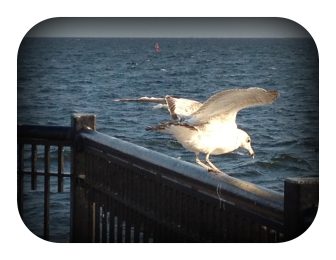
A stout gull perched on the railing before us, facing the sunset with a composure that felt almost ceremonial. Its white feathers caught the last light, turning the bird into a soft, luminous creature. We admired its quiet splendor as I took out my camera. And wouldn’t you know it? Just as I lifted the camera and clicked the shutter, the sea gull opened its wings in a single, fluid motion and rose into the air. The moment felt like a small benediction; unplanned, unearned, yet somehow perfectly timed.
Far out in the bay, a solitary sailboat rocked gently, its silhouette dark against the shimmering water. It drifted without urgency, as though content simply to exist in the cradle of the evening. There was something instructive in its stillness: a reminder that not every movement must be purposeful, not every moment must be filled willy-nilly.
Sitting there, it became clear that serenity is not something we manufacture; it is something we allow. The bay freely offered its calmness, asking only that we pause long enough to receive and embrace it. In a world that often demands speed, noise, and constant reaction, this quiet corner felt like a small act of resistance, a place where the soul could unclench, relax, and accept a bit of freedom.
The twilight deepened, and with it came a sense of interior spaciousness, the kind that arrives only when the world grows quiet enough for the heart to hear itself again. A quiet truth settled over us, reminding us that stillness is its own kind of blessing.
About four years ago, we headed out for an early lunch before we ran our errands. We ended up at a little grille tucked between a seedy-looking thrift store and a storefront mission, an unassuming spot that somehow serves some of the best home‑cooked meals in town. We’ve never had a bad meal there.
The lunch crowd was thinning, and we slipped into a corner booth. My spouse ordered steak and eggs; I chose a half tuna sandwich with cream of broccoli soup. We talked about this and that, the kind of easy conversation that comes from years of companionship, and before long our plates were empty and we were ready to settle the bill.
At the counter, I noticed a woman—late forties, maybe early fifties—finishing her payment. By the time we reached the register, she had already disappeared out the door.
Best Friend pulled out his debit card.
“It’s paid for,” the cashier said with a smile.
He blinked. “I’m sorry—what was that?”
“Your bill is paid for,” she repeated. “The lady who was just here took care of it. You owe nothing.”
We stood there, bemused into silence. It’s one thing to read about this sort of thing in the newspaper; it’s another to find yourself on the receiving end of it. All we could manage was a breathless, “Wow. That was nice!”
The cashier smiled, and we left her a large tip—she had been our waitress, too, after all—before heading out into the afternoon.
Kindness like that stay with you. They interrupt the ordinary rhythm of a day and remind you that goodness still moves quietly through the world. You don’t always see it, and you can’t predict it, but every now and then it steps forward, taps you on the shoulder, and says, I’m still here.
The question, “For what shall it profit a man, if he gain the whole world and suffer the loss of his soul?” cuts to the heart of a tension that every era rediscovers: the difference between a life that looks impressive and a life that is actually worth living. We are surrounded by metrics — influence, fame, money, reputation, achievement, status — that promise satisfaction but often deliver only more insatiable hunger. The question forces us to confront a truth we instinctively know: a person can win by every external measure and still feel hollow inside, a dried-up husk of a person.
Modern culture is skilled at rewarding the wrong things. It celebrates accumulation, visibility, and speed. It teaches us to optimize our schedules, polish our image, and chase the next milestone. None of these pursuits are inherently harmful, but they become dangerous when they eclipse the quieter, more essential work of becoming a whole human being. A person can spend decades climbing a ladder only to discover it was leaning against the wrong wall.
Losing oneself rarely happens in a dramatic collapse. More often, it happens gradually, when convenience replaces integrity, when ambition overrides relationships, when the greedy pursuit of More! More! More! crowds out the pursuit of meaning. The world applauds these compromises; our inner life does not. The cost is subtle but real: a thinning of character, a shrinking of joy, a sense that life is happening faster than we can live it.
To gain the world is easy. It requires only that we follow the current cultural expectation. To keep oneself intact is harder. It demands reflection, boundaries, and the courage to choose depth over display, but only one of these paths leads to a life that feels like one’s own.
In the end, the question remains a challenge to every generation: what good is success if it costs you the very person you were meant to become? The world offers many rewards, but none of them are worth the loss of yourself and your eternal spirit.

Remember thou art dust,
And unto dust thou shalt return.
As you receive your ashes this year, pause for a moment. Let that simple cross traced upon your forehead remind you that our days are fleeting, yet the mercy of God endures forever. These ashes echo the ancient words of Scripture—“Remember that thou art dust, and unto dust thou shalt return”—not to burden us with fear, but to awaken us to grace.
This Lent, may the ashes draw you away from despair and toward the hope promised in Christ; away from shame and into the healing tenderness of His forgiveness; away from mere reflection and into true conversion of heart.
For the ashes matter not for what they are, but for what they call us to become: sons and daughters who walk in humility, disciples who practice mercy, and souls renewed in the love of the Crucified and Risen Lord.
I will be posting my essays throughout Lent; most of them are pre-written so that I can concentrate on this holy season.
Welcome to my website and thank you for stopping by. This spot is a refuge from an often overwhelming and vastly chaotic world, and I’m grateful to share the pacific serenity that exists with you. My blog opens a window into my personal life, where every topic — whether lighthearted or deeply reflective — is written with honesty and positive intention.
Think of this as a peaceful corner filled with stories, gentle opinions, encouragement, inspiration, emotions, and humor. I’ll explore the beauty of living simply, cultivating calm within our homes, and clearing away the toxic clutter — both physical and emotional — that weighs us all down at one point or another.
I invite you to join me as I write, reflect, and share pieces of my life. My aspiration is to post a couple of times each week, offering moments of my life, the stillness of peace, my observations, and the connection we need – plus some humor, too!
Peace on Earth,
Susan Marie Molloy
 Susan Marie Molloy