
Don’t Fool Yourself, Too.

A Lesson in Phony Presentations.

How much of our time have we spent striving to be something or someone we’re not?  It’s one thing to make changes to improve and enrich us, yet it’s quite another matter to be something or somebody that we aren’t with the deceptive purpose of impressing people for some type of personal gain, whether it is monetary or societal status or just plain impress everyone else.

From my observations, it’s an obvious and widespread phenomenon, this pretentiousness that pervades society today, and it appears to be snowballing and careening out of control with each passing year.  Specifically, I have seen throughout the past decade that it’s easier, and even devilishly tempting, to put on a false front and eschew genuineness, humility, and empathy.  I assert that social media led the way to be a purveyor of temptations and false faces.

How easy it is!

You see, as we move through the world at such a rapid pace as we do in our modern twenty-first century world, there is pressure from peers and perceived adversaries, which tempts some of us to try mightily to be someone else.  People with those sorts of leanings invariably make attempts to impress the other guy, to portray themselves as to render themselves as the moral voice of reason and righteousness, as highly educated, and to put forth false humility.

I imagine that it is truly an exhausting and laborious struggle to be someone you’re not.  From my spot at the window looking out at the world, when I see someone puff himself up or preach from his pulpit as the all-knowing and all-seeing entity, and then toss in false humility, it becomes a foul scene.  There is nothing endearing nor impressive about someone who puffs himself up just to make himself feel better about himself or even show up someone else.  False humility serves Man; it removes the ability to serve God.

The whole thing of putting on an act for selfish purpose is fabricating the truth.  Duplicity is hard work; there are the falsehoods one must remember with excruciating perfection to keep the fiction straight.

It is better to remember that what you can do better than anyone else is to be yourself.  The world doesn’t need more of everyone else parroting platitudes and mimicking others.

It needs more of the original, real, and true you.  Putting on false airs is also lying to yourself.

As we get ready to begin another day, another week, or another year, do it with sober eyes and clear hearts.  Let’s remember who we really are deep down inside.  Do not compromise or relent on that truth.  Hold on to it at all costs and carry it into your world.  Be yourself, be honest, be considerate, for there is no one better at it than you.  Know who you are and stick to your principles in a humble and moral manner.  Have respect for yourself and others, too.

Don’t fool yourself.  It’s not honest, but a lie.


Cutting Cardboard.

We had just ordered our meal, when a party of four was seated two tables from us.

Grind.  Grind.  Grind.

“Where is that sound coming from?” I asked Best Friend as he sipped his drink.  “It sounds like somebody cutting corrugated cardboard with a serrated bread knife.”

“What’s that?”

“I hear someone cutting corrugated cardboard with a serrated bread knife.  It’s that specific of a sound.  Listen.”

Grind.  Grind.  Grind.

“It’s the dog,” Best Friend nonchalantly quipped as he put down his drink.

“Whoa!” I whispered.  I leaned over a little bit to the left and looked past Best Friend’s shoulder.  Sure enough, at the table where the party of four sat, was a Yorkie on the man’s lap, chewing on food from the man’s plate and making a sound like somebody cutting corrugated cardboard with a serrated bread knife.  Then I witnessed the man put down one of those doggie pads on the floor and set the Yorkie on it, whereby Yorkie promptly did his business.  Everyone else at that table was oblivious and didn’t bat an eye.

Ewwww.

I am not a fan of dogs or any sort of animals in restaurants and stores.  I find it dirty, and it puts the question of health codes out there.  Service dogs are okay, but not “emotional service” or those “just because I can’t live two minutes without Fluffy” animals inside stores and especially restaurants.  Bleh.

One of the grocery store chains in our area put a stop to people bringing dogs or any animals into their stores, except for service animals.  I agree with that.  And, please, no dogs in grocery carts.  I saw that exact thing at one grocery store a couple years ago.  Where have those rear ends been?  I never saw anyone wash those grocery carts, either.

It’s so gross!


Stench in the Shadows.

In the condominium association where I lived once upon a time, there was a strange occurrence that only a brave resident could resolve.  This is the true story.

The overstuffed garbage bags appeared twice weekly in the broom closet on the fifth floor of the condominium building.

What brought this to the attention of the residents was the overpowering stench of rotting foods in the bags.

On a Saturday morning, Miss Wanda, the bravest of the fifth-floor residents, had enough of the reek and marched to the broom closet.  Several residents followed her, for they wanted to be in on the revelation.  Wanda opened the door, and there it was: an overstuffed Hefty® bag emitting a stench that would knock a skunk off his beam.

Wanda took one of the bags and opened it up.  Everyone around her jumped back and held their noses.

“It smells like death,” Old Man Fontane gasped.  “Death on a plate of rotted sardines.”

“At least!” gagged Issac Brenner.  “It smells worse than my ex-wife’s armpits after a sweaty walk in the park.  I’d know that stench anywhere.  Barf!”

“Hoo-eee, Lordy!”  Mrs. Chisa Cooke walked away while holding her nose.  “Y’all enjoy.  I’m headed off to watch Julia reruns on my brand new television.”

Bravely, Miss Wanda dug into the garbage bag.  Slimy beet greens, a moldly banana, empty cartons, and paper brochures from the Poconos greeted her.  She dug around until she saw an envelope.  She reached for it with two fingers.

“Ah!  Well.”  She examined the address.  “Ah ha!  It’s from that brood across the hall from me.  I’ll talk to them.”  The neighbors nodded their heads and a few just whispered, “Ooo!” and “Yeah.”

Miss Wanda knocked on the Stankles’ door.  After talking with the grandmama, neighbors could hear the two women laughing before Miss Wanda returned to her condominium.

“So who did it?” Mrs. Chisa Cooke asked the next day in the laundry room.

“Oh, it was her youngest grandbaby, Tristane.  Do you know that ten-year-old is afraid of the dark, so he just tosses the garbage bags in the broom closet and runs back home!  His parents never check to see if the boy is doin’ his errands right.””


Elevator Encounter.

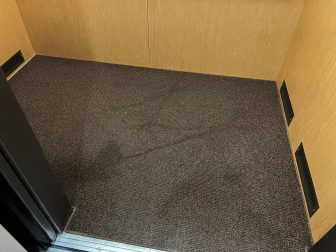
It was Monday evening in March several years ago, Saint Patrick’s Day in fact, when I lived at Sage Pointe and had the weirdest encounter at the elevator.  It was the kind of evening that felt like it had already overstayed its welcome with humidity, the sun nearly set below the horizon, and the atmosphere vaguely resentful overall.  The evening just didn’t feel right.  I had some business to attend to on the first floor of my condominium building.  It wasn’t anything dramatic; just a quick look-see on a neighbor’s wreath on the door.  Once that was done, I turned back toward the elevator, ready to ascend to the relative peace of my penthouse suite.

The elevator dinged open with its usual lack of enthusiasm.  Out stepped the dog walker who was a lean, overworked man with the expression of someone who’d long ago stopped pretending to enjoy his job.  He was wrangling two dogs that week: a jittery black and white shih-tzu dogs, one with a Napoleon syndrome and the other who looked like he’d seen too much in life.  They belong to the renter, “Princess,” we all called her.  Anyway, behind the dog walker emerged a disheveled woman who could only be described as a walking cautionary tale.

She was large, loud, and chaotic in every sense.  Her hair was a brittle, bottle-blonde explosion of stringy straw, unbrushed and defying gravity, as if she’d just lost a fight with the town’s stray cat in an electric storm.  Her clothes hung off her like they’d given up trying to flatter her shape, and her arms were crammed full with an assortment of objects: papers, a purse that had seen better decades, and a large bag that looked like it had been repurposed from a deflated beanbag chair.

Before I could step aside, she lunged forward, thrusting her face into mine with the urgency of someone trying to solve a crime in real time.

“146—Eight?  148?  148?” she barked, her breath a cocktail of tobacco, menthol, and desperation.

I blinked.  I had no idea what she was babbling about.  Was it a code?  A unit number?  A cry for help?

“148?” she repeated right in my face, louder this time, as if volume might unlock my comprehension.

“Umm—” I managed, instinctively leaning back, trying to create space between her and my personal bubble, which she had already detonated.

The dog walker, sensing my confusion and her unraveling, stepped in like a reluctant mediator.

“Here,” he said, gesturing down the hallway and beginning to walk, the two mutts trailing behind him like reluctant furry witnesses.  “I’ll help you get there.”

I didn’t wait for the encore.  I slipped into the elevator, pressed the button for my floor, and let the doors close on whatever that was.  The ride up felt like a small victory.  Quiet, controlled, and blessedly devoid of oddball mystery women and their numerical riddles.


The Quiet Edges.

There was once a resident in a condominium I owned, a man so enigmatic that no one ever quite claimed to know him.  He drifted through the halls like a rumor made flesh, and before long he became the quiet talk of the association.  Here’s the story:

He kept to himself, and barely anyone knew his name.  It was said that Alonzo’s jet black, laid down styled hair shone so bright it might have lit up all of Sage Pointe.  His hair was a shimmering emblem of confidence and unspoken connection.

“Alonzo,” those who knew his name would say, “He got the thickest, the baddest, the most outta-sight edges this side of Sage Pointe.”

“Alonzo?  Ain’t he the one with the black patent leather hair?”

“Shiny and bright, that Alonzo is.”

I know that Alonzo’s secret was SoftSheen Dark and Natural in “Jet Black.”  I’ve seen the box he threw out in the recycling bin.  His “secret” might have looked unnatural as vinyl patent leather shoes, but he had not one grey hair on his head.  It was a one-tone black from the back of his head to the slicked down edges in the front, from sideburn to sideburn.

As time passed, Alonzo’s hair became more than just a spectacle; it turned into a beacon of curiosity and a source of fascination at Sage Pointe.  People were in awe about him at the monthly condominium association meetings – the few times he bothered to show up.  They marveled at him in the church, drooled at him in the grocery store line, admired him at the barbershop, and speculated about his unknown secrets at the local diner.  Yet Alonzo carried on, keeping to himself, his glossy raven hair unfaltering, like a strange moon in its perennial glow.

But one summer evening, at the annual Sage Pointe party, Alonzo broke his silence.  He sauntered onto the wooden dance floor at the activity center with his head held high, dressed sharp as a razor in a cream‑colored linen suit that caught the breeze just so, a narrow burgundy tie tucked neatly against a crisp pale yellow shirt, and red shoes polished to a mirror shine.  The flashing dance lights cast dazzling reflections off both his raven‑black hair and the blinding shine of his shoes.  Eight gold rings gleamed on his fingers — thick, heavy bands with diamonds, emeralds, and garnets that flashed each time his hands cut through the air, catching the lights as surely as his raven‑black hair.  He moved with an easy, unhurried confidence, swaying to the beat of funk music like he had been born for that moment.

Earlier that evening, I watched as he stood off to the side of the party room sampling the appetizers— deviled eggs dusted with paprika, tiny ham biscuits, and those colorful cellophane-tipped toothpicks that skewered a variety of cheese cubes that squeaked when you bit into them.  He washed it all down with two strawberry daiquiris so cold that the condensation rolled down the red plastic Solo® cup like sweat on a July window.  He sipped them slow, savoring each icy, syrup‑sweet mouthful as though it were part of some private ritual that he wanted no one else to be a part of.

I watched him in awe along with the crowd and laughed when Alonzo pulled a small group of kids into his groove.  “It’s all in the soul, you crumb crunchers!  Dance like your hair shines brighter than the stars,” he declared, a wide smile breaking through his elusive façade.  That night, he wasn’t the enigma they had speculated about.  He was the rhythm, the light, the joy.

That is what everyone wanted to believe.

By the time the party was over, it was said that Alonzo’s edges shone so bright it might have lit up all of Sage Pointe.  After the party, although he disappeared into the quiet mystery of his condominium once again, his name would be remembered as the man who brought the condominium association an evening they would never forget.

But in the weeks and months that followed, people began to notice something strange: no one saw Alonzo at church, or in the grocery line, or even passing by the barbershop window.  His apartment blinds stayed drawn, his mailbox appeared untouched.  Some said he’d moved away; others whispered he’d simply slipped into the night the way he’d always lived— quietly, without explanation.  His silver car would be in his parking spot, and sometimes not.  His monthly assessments still were paid in full and on time.  But no one actually saw him.

Now on certain humid evenings, when the streetlights flicker and the cicadas fall silent, a few swear they’ve seen a glint, just a brief flash, like moonlight on patent leather, disappearing around the corner before they can call his name.  And in Sage Pointe, that is enough to keep the legend alive.

In time, the condominium association learned to stop asking where Alonzo had gone.  Life in Sage Pointe moved on, as it always does, yet something in the air felt slightly altered, as though a faint shimmer had been left behind.  The wooden dance floor where he’d once spun the children around seemed to hold a deeper polish, catching the light in ways no one could quite explain.  And every so often, when the dusk settled low and the streetlamps hummed to life, someone would pause mid‑stride, certain they’d caught the scent of pomade or felt the whisper of a beat only Alonzo could hear.  Whether he had slipped away to some quieter corner of the world or simply stepped into the shadows he’d always belonged to, no one could say.  But the memory of that night, and the man whose hair shone like a secret, lingered in Sage Pointe like a story half‑told, waiting forever for the rest of its truth to surface.


Cutting the Mustard.

A Lesson in Gluttony and Control.

Finally, there is only French’s® yellow and Gulden’s® brown on my pantry shelf.

Once upon a time, that space was also shared – packed, in fact – with small jars holding other variations: champagne, chipotle, curry, honey, jalapeno, siracha, Dijon, . . .

Then, one day, I said aloud, “That’s it!  No more of these yuppified wannabees!”

And Lo!  The clouds parted and the sun came out.  Best Friend assented my exclamation with a “Hear!  Hear!”

We do like mustard.  It was easy to pick up a small jar of something a little different when we stopped by our local winery.  What’s a two-ounce jar of champagne honey mustard?  It didn’t take up much refrigerator shelf space along with the other six or seven two-ounce jars.

Yet, that one day, I had enough.  Those “specialty” mustards began tasting pretty much alike.  There wasn’t anything special about them anymore, except perhaps their unusually shaped jars that really had no further purpose for me after the last bit of mustard was scraped from the sides.

I was throwing money out the proverbial window.  And for what?  To feel like we were indulging in something special or upper class?

Pfffft.  It was a waste.  We said right then and there that those types of mustards won’t darken our doors again.  From then on, it will be a bottle of yellow, a bottle of brown, and a jar of Dijon.  That’s all!  No more yuppy mustard, as we call it.  No more fancy-this and fancy-that.

Along the same lines, in fact, the equivalent goes for fancy horseradish – I have a bottle of siracha horseradish that I bought a few weeks ago from a mom-and-pop grocery store in a neighboring town.  Is it anything special?  No, not really.  It’s really not what I expected; it’s not any hotter or spicier than regular horseradish, and it has a strange, sweet background taste to it.  I could kick myself for not reading the ingredients list better, because this bottle of weirdness has corn syrup in it.  (We’re cutting out corn syrup from our diet).  So, if I want the kick that siracha gives to my bowl of pho or broiled chicken or vegetable stir fry, I can get the siracha bottle from the refrigerator and squeeze a shot or two on my plate.  If I want horseradish, I can make my own fresh or buy a jar of straight horseradish.  I don’t need an odd yuppie horseradish-siracha concoction. Keeping it simple, silly!

So, we’re cutting the mustard.  We’re keeping it unpretentious.  Now on the refrigerator shelf sits a container of yellow, a bottle of brown, and there is a space for Dijon because I need that specifically for making Steak Diane.  Otherwise, any other types of strange mustards will remain on the store and winery shelves, available for other shoppers and connoisseurs to fill up their refrigerators and sate their taste buds with frou-frou table mustards.

It’s minimalism for us now.

Hack, Steal, Swipe, and Other Modern Courtesies.

It’s the Language of Plunder, and it’s all the rage I’m talking about today.

Every so often, my thoughts drift toward the strange new definitions floating around in the modern lexicon.  It’s those little word fads that flare up, spread everywhere, and then vanish the moment a shinier bit of slang arrives.  A word fad, as I see it, is a piece of language used mindlessly, repeated without understanding, and destined for the linguistic landfill as soon as the next trend rolls in.

One of the most abused is hack.  We now have hair hacks, cooking hacks, travel hacks, security hacks, hacks for everything under the sun.   The word is slapped onto any tip, trick, or mildly useful suggestion.  Yet its true definitions include “gaining unauthorized access” and “cutting with heavy blows.”  Neither definition suggests something gentle, clever, or admirable.  Hack!

But instead of offering tips such as hair tips, security tips, cooking tips, we hack, hack, hack.  Take unauthorized access.  Grab and run.  Rip off.  Steal.

Which brings me to another disturbing phrase I hear far too often: “I’m going to steal that idea!”

Usually, it’s said when someone supposedly admires another person’s décor, recipe, style, or skill.  Once upon a time, we might have simply complimented the person.  We might even (brace yourself) have asked permission to borrow the idea.  However, courtesy is apparently passé these days.  Why ask when you can proudly announce your intention to steal from that person?

Why, indeed?  Hands up!  Hand it over!

So now everything is framed as theft: steal, swipe, take, hack.  Even admiration is expressed in The Language of Plunder.

It’s a small thing, perhaps, however, small things shape habits, and habits shape culture.  When our everyday speech defaults to the vocabulary of taking, it’s no wonder the world feels increasingly coarse, transactional, and grabby.

And yet, here we are.  This is the way of things now.

In the end, these little phrases are not harmless quirks of speech; they reveal how casually we treat one another.  When the language of theft becomes the language of admiration, something in our cultural posture shifts away from gratitude, away from courtesy, away from the simple dignity of asking.  Words shape habits, and habits shape the world we build together.  If we want a gentler world, perhaps we begin by speaking as though one is still possible.


Merry, Merry Month of May.

May is a marvelous month.  It’s filled with warm days, fresh rains, and new growth.  It teases us with hints of summer.  Oh, sure, the softball-sized magnolias boast their sturdy petals, but at the first strong breeze, the flower petals fall and tumble down the street.  Soon the green leaves will be budding.  The gardenias are resplendent in their soft fragrance, and the jasmine bursts across mailboxes and fences.  Inch worms hang from the trees, green helicopters fall and twist as they fall from the maple trees, other plants bud overnight, and robins hop along in the yards.

May is always a month I eagerly await.  In the ancient days of my childhood, it meant hopping on my bike after school and again after supper, pedaling through the familiar streets of the city where I grew up, mapping out future adventures in my mind as the evenings stretched longer and warmer.

Always, the fresh-smelling rain comes in May.  The air is still cool, so a windbreaker or sweater is the necessary fashion in the early days of the month.  By the end of May, that meant cotton sundresses and seersucker hats would soon become the norm for the next four months.

May smells fresh and new and clean and pure.  May brings the purple and white lilacs that bloom for a few short weeks, enveloping the spring air with perfume.  As kids, my friends and I would pluck blossoms and suck their nectar; or so we thought.  We just wanted to be filled inside with May’s loveliest flower.  But by high school, I dropped the weird ritual and stuck with just breathing in the flowers’ delicate fragrance.

Some cultures consider lilacs to represent strong people.  Some believe it to be the flower of love.  It reminds me of my grandma, because the lilac was her favorite flower, as is mine.

Although I liked the somewhat rare while lilac bushes, I was absolutely enchanted by that purple hue of the blossoms that ran from palest amethyst to deepest royal purple.  For a few years, my sister and I even had our bedroom painted lilac.  On gloomy, sunless days the walls slipped toward grey, but when the sun poured in, the whole room seemed to brighten into pastel purple.  For Easter, in my thirteenth year, I wore a lilac chiffon dress with white polka dots, tiny pleats, and a soft lettuce hem.  My school folders, notebooks, and a Bic® pen I owned boasted purple ink, too.  It was the color that threaded through my days, so constant that I hardly noticed it.

Every place where I lived around the country, lilacs were a reality of springtime.  In fact, I lived in a town once where it seemed that everyone had at least one lilac shrub in their yard.  The entire town smelled of that pretty fragrance for weeks!

May is a special month for me, and when I catch a whiff of that springtime perfume, I can still remember burying my face in a perfumed cloud of lilac blossoms.  The memories will remain enduring, and they will envelop me, as only the most beautiful of spring flowers can do.

In the door-yard fronting an old farm-house, near the white-wash’d palings,
Stands the lilac bush, tall-growing, with heart-shaped leaves of rich green,
With many a pointed blossom, rising, delicate, with the perfume strong I love,
With every leaf a miracle……and from this bush in the door-yard,
With delicate-color’d blossoms, and heart-shaped leaves of rich green,
A sprig, with its flower, I break.

—Walt Whitman, “When Lilacs Last in the Door-yard Bloom’d,” 1865.


Wigged Out.

At dinner the other evening at the country club, we sat at a table at the back of the restaurant, nestled in a cozy alcove dimly lit by a warm, flickering candle in a glass votive.  Our wine glasses of glimmered in the low light.  The clinking of silverware and the soft hum of chatter filled the air, punctuated by bursts of laughter from a boisterous group near the bar.

Across from us, a couple sat at the immediate table opposite ours.  They immediately drew my attention with their striking contrast.  She was a petite, frail-looking woman, her presence almost ephemeral, yet undeniably elegant.  Her baggy, sequined blouse sparkled faintly under the muted light, a deep emerald green that complemented the intricate plastic pearls cascading down her neck.  Her white pants, cut high to mid-calf, were snug and showed off her caboose.  Every gesture of hers was deliberate, placing her napkin, adjusting her sleek clutch, moving her wine glass, as though she were orchestrating a performance of refinement.

Across from her sat the undeniable foil to her practiced image.  He was a large man, his frame spilling over the edges of the overstuffed dining chair.  His attire was an amusing affront to hers: a pair of sagging khaki shorts, socks with sandals, and a faded, nondescript polo shirt, the type that might have been gray once but had since resigned itself to a black, lavender, taupe ambiguity.  His bulbous nose was faintly red, matching the ruddiness of his face.

But the pièce de resistance became the highlight of the evening.   It was his hair.  His hair—or rather, what aspired to be his hair was . . .  “different.”  A Just for Men “Darkest Red Brown” masterpiece of a wig was perched atop his head, so incongruous with the rest of his appearance it felt like a punchline to a joke only he didn’t quite get.  The thick, wavy wig seemed precarious, as if it might slide off at the slightest provocation.  It sat too high, too perfect, too ruddy-brown and defying both gravity and reason.

He leaned back in his chair with an air of self-satisfaction, plucking at a breadstick while his lady friend sipped delicately from a wine glass.  They exchanged sporadic words, her responses curt and his booming laugh echoing through the restaurant, prompting raised eyebrows and glares from nearby diners.

They were a spectacle, a living contradiction, a joke, an editorial cartoon.  The woman seemed to be holding onto a bygone era of sophistication, while the man seemed content to bulldoze through it, unbothered by appearances or subtlety.  Yet, there was something oddly appealing about them with a mystery to unravel, a story hidden beneath the surface of their mismatched personas.


Website Built with WordPress.com.

Up ↑