
Time Blindness.

Once upon a time, my spouse was the President of our condominium association.  He was the designated point‑man for every vendor, handyman, contractor, and the property manager.  And without fail, something out there seemed to decide that the exact moment we sit down to eat was the perfect time for someone to call him.

It didn’t matter when we ate:

11:00 AM?  Phone rings.

12:15 PM?  Phone rings.

4:45 PM?  Phone rings.

7:30 AM?  Phone rings, because apparently breakfast is also fair game, too.

It was as if people had a sixth sense for when a fork was about to touch a plate.

Even the other board and committee members who should have known better seemed to be compelled to call precisely when we were eating, and not all of these calls were emergencies, either.

Appointments were no better.  If someone was scheduled to arrive at 9:00 AM, they absolutely, without hesitation, called at 8:15 AM to announce:

“I’m here.”

Not “I’m on my way.”  Not “I’ll be there soon.”  No.  They were already standing outside like a time‑traveling courier from the future.

And as if the mealtime ambushes weren’t enough, his phone also believed in a 24‑hour discipline of interruption.  Text messages arrived at 5:55 AM, before the sun, before coffee, before a bagel, and texts continued rolling in as late as 10:30 PM when we were just about to drift off to Sleepyland.  Ostensibly, the entire world has silently agreed that he was available at all hours, like a one‑man emergency hotline for condo‑related existential and non-crises.  I was convinced the only time his phone doesn’t buzz is when nothing in particular is going on in our home.  Oh.  It doesn’t ring or buzz when we are at Mass; our phones are turned off completely then.

It got to a point that I was convinced our condo was either:

  • bugged;
  • under surveillance by a secret intelligence agency; or
  • being monitored by people with remote‑viewing abilities who can see the moment we sit down with plates of food.

I’m kidding, and honestly, who knows?  But if someone knocked on the door the next time we even thought about lunch . . . I would’ve d just laughed.  I continued to laugh it off.

The most important part of this hilarity is that my spouse and the rest of the board at the time were doing an outstanding job getting the formerly poorly self-managed association back on the right track.  They were righting the ship . . .


When the Day Grows Weightless.

Evening had only just begun to gather when we stepped out of the house, leaving behind the familiar busyness of the day.  The sky was already settling into that muted greyish‑blue that feels less like a color and more like a threshold of an in‑between hour when the world loosens its grip and invites you to breathe unworriedly.

We drove to the historic part of town, where old brick and weathered wood seem to remember more than they reveal, and where the streets narrow as if encouraging you to slow down.

We parked near the waterfront at Twilight Bay.  I gathered my sweater around me and took a deep breath; the salty air and the freshness of the evening made me forget the world.  We wandered toward a small bench built for two, its placement so perfect it felt almost intentional, as though someone long ago had known that people would come here seeking a moment of quiet.  The lazy breezes carried a crisp coolness, brushing away the last warmth of the day.  As we settled into the bench, the sun began its slow, deliberate descent; that an unhurried surrender that painted the bay in streaks of rose, amber, and fading gold.

Above us, pelicans glided in near‑silence, their wings steady and sure.  They usually lingered on the lawns or sidewalks nearby, waiting for a passerby to drop a morsel, but tonight they moved with a different kind of intention.  Their silhouettes drifted toward the boats anchored in the harbor, as though they sensed a more certain feast waiting among the sailors.  Watching them, it was hard not to feel that even the birds understood something about seeking what truly nourishes rather than what merely distracts.

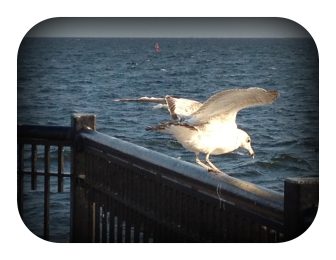
A stout gull perched on the railing before us, facing the sunset with a composure that felt almost ceremonial.  Its white feathers caught the last light, turning the bird into a soft, luminous creature.  We admired its quiet splendor as I took out my camera.  And wouldn’t you know it?  Just as I lifted the camera and clicked the shutter, the sea gull opened its wings in a single, fluid motion and rose into the air.  The moment felt like a small benediction; unplanned, unearned, yet somehow perfectly timed.

Far out in the bay, a solitary sailboat rocked gently, its silhouette dark against the shimmering water.  It drifted without urgency, as though content simply to exist in the cradle of the evening.  There was something instructive in its stillness: a reminder that not every movement must be purposeful, not every moment must be filled willy-nilly.

Sitting there, it became clear that serenity is not something we manufacture; it is something we allow.  The bay freely offered its calmness, asking only that we pause long enough to receive and embrace it.  In a world that often demands speed, noise, and constant reaction, this quiet corner felt like a small act of resistance, a place where the soul could unclench, relax, and accept a bit of freedom.

The twilight deepened, and with it came a sense of interior spaciousness, the kind that arrives only when the world grows quiet enough for the heart to hear itself again.  A quiet truth settled over us, reminding us that stillness is its own kind of blessing.


Unexpected Kindness (2).

About four years ago, we headed out for an early lunch before we ran our errands.  We ended up at a little grille tucked between a seedy-looking thrift store and a storefront mission, an unassuming spot that somehow serves some of the best home‑cooked meals in town.  We’ve never had a bad meal there.

The lunch crowd was thinning, and we slipped into a corner booth.  My spouse ordered steak and eggs; I chose a half tuna sandwich with cream of broccoli soup.  We talked about this and that, the kind of easy conversation that comes from years of companionship, and before long our plates were empty and we were ready to settle the bill.

At the counter, I noticed a woman—late forties, maybe early fifties—finishing her payment.  By the time we reached the register, she had already disappeared out the door.

Best Friend pulled out his debit card.

“It’s paid for,” the cashier said with a smile.

He blinked. “I’m sorry—what was that?”

“Your bill is paid for,” she repeated.  “The lady who was just here took care of it.  You owe nothing.”

We stood there, bemused into silence.  It’s one thing to read about this sort of thing in the newspaper; it’s another to find yourself on the receiving end of it.  All we could manage was a breathless, “Wow.  That was nice!”

The cashier smiled, and we left her a large tip—she had been our waitress, too, after all—before heading out into the afternoon.

Kindness like that stay with you.  They interrupt the ordinary rhythm of a day and remind you that goodness still moves quietly through the world.  You don’t always see it, and you can’t predict it, but every now and then it steps forward, taps you on the shoulder, and says, I’m still here.


The Profit That Destroys.

The question, “For what shall it profit a man, if he gain the whole world and suffer the loss of his soul?” cuts to the heart of a tension that every era rediscovers: the difference between a life that looks impressive and a life that is actually worth living.  We are surrounded by metrics — influence, fame, money, reputation, achievement, status — that promise satisfaction but often deliver only more insatiable hunger.  The question forces us to confront a truth we instinctively know: a person can win by every external measure and still feel hollow inside, a dried-up husk of a person.

Modern culture is skilled at rewarding the wrong things.  It celebrates accumulation, visibility, and speed.  It teaches us to optimize our schedules, polish our image, and chase the next milestone.  None of these pursuits are inherently harmful, but they become dangerous when they eclipse the quieter, more essential work of becoming a whole human being.  A person can spend decades climbing a ladder only to discover it was leaning against the wrong wall.

Losing oneself rarely happens in a dramatic collapse. More often, it happens gradually, when convenience replaces integrity, when ambition overrides relationships, when the greedy pursuit of More! More! More! crowds out the pursuit of meaning.  The world applauds these compromises; our inner life does not.  The cost is subtle but real: a thinning of character, a shrinking of joy, a sense that life is happening faster than we can live it.

To gain the world is easy.  It requires only that we follow the current cultural expectation.  To keep oneself intact is harder.  It demands reflection, boundaries, and the courage to choose depth over display, but only one of these paths leads to a life that feels like one’s own.

In the end, the question remains a challenge to every generation: what good is success if it costs you the very person you were meant to become?  The world offers many rewards, but none of them are worth the loss of yourself and your eternal spirit.


The Noise We Mistake for Knowledge.


We live in an age where information is abundant, but much of what passes for “news” today is not news at all.  It’s noise, and you know that.  It’s carefully packaged, endlessly repeated, and designed to keep us stupidly watching rather than sensibly thinking.  The problem is not merely the volume of what we consume, but the nature of it because much of what presents itself as “news” is, in truth, non‑news — content engineered to provoke reaction and emotion rather than understanding.  Discernment, then, becomes not a luxury but a moral necessity.  Headlines flash, opinions multiply, and yet very little of it has any bearing on our actual lives.  The result is a subtle erosion of time, attention, our brain cells, and inner peace, and if we bow down to the mindless blather, we allow others to steal our time.  Yes—steal our time and ultimately shapes our habits.

Non‑news thrives on immediacy.  It demands attention without earning it.  It offers the illusion of being informed while quietly draining the very faculties that make genuine understanding possible.  The result is a culture that is constantly stimulated yet rarely enlightened.  We scroll, we skim, we react, and at the end of it, we are no closer to truth.  The deeper danger of non‑news is not that it wastes minutes but that it shapes habits.  It trains us to expect superficiality, to prefer outrage over reflection, to treat every passing headline as a crisis.  A society that cannot tell the difference between the essential and the irrelevant becomes easy to manipulate and difficult to awaken.

True news informs and clarifies, and it should edify us.  It should help a person understand the world.  But this blather does the opposite: it distracts, inflames, and consumes hours that could have been spent on something productive.  It is astonishing how quickly a day can disappear into commentary, speculation, and manufactured outrage that leaves us no knowledgeable than before.

The danger is not merely wasted time; it’s also wasted focus and a counterfeit form of engagement.  When we allow trivial stories to occupy our minds, we lose the capacity to notice what genuinely matters: the people around us, the responsibilities entrusted to us, the quiet work that builds a meaningful life.  Non‑news thrives on urgency, but it produces nothing lasting.

Discernment asks a different question: Is this worthy of my time, my mind, my peace?  It is a refusal to let trivialities masquerade as significance.  It is the discipline of distinguishing between what is merely loud and what is actually important.  In a culture that profits from distraction, such clarity is countercultural.  Choosing to step away from it is not ignorance; it is discernment.  It is the decision to guard one’s attention as a precious resource rather than surrender it to whatever happens to be fashionably trending.  A person who refuses to be pulled into the churn of non‑news gains something rare in our age: clarity of mind and control of oneself.

When we decline to participate in the churn of non‑news, we reclaim our attention for what is real: the responsibilities before us, the people entrusted to us, the truths that do not change with the news cycle.  We become less reactive and more rooted.  Sure, the world will always offer distractions, but we are not obligated to accept them.  Our time is finite, and our attention is inviolable.  Spending it wisely is an act of both strength and sanity.


Are Our Lives Truly Well-Lived?

A lifetime spent chasing approval, possessions, and the noise of the world gradually drifts away from its own center.  From an early age, we learn to shape ourselves around external expectations, as if our worth could be measured by admiration, status, awards, or the objects we manage to collect, and the amount of money we amass.  Yet these pursuits, however dazzling in the moment, dissolve quickly.  What remains is the quiet sense that we have been living outward rather than inward – living as part of the world, rather than in it.

Philosophers across centuries have warned of this drift.  They remind us that the self becomes fragmented when it is scattered among too many desires, especially those desires that are not truly our own and those that make us look “better” to our family and friends.  Simplicity, then, is not merely a lifestyle but a discipline.  It is the art of refusing to be ruled by the shifting opinions of others or by the endless accumulation of things that promise satisfaction but deliver only distraction.

To live a life well done is not one that has a swanky mansion, a jet set lifestyle, and a fat bank account.  It is, rather, one that turns toward what endures: clarity of mind, steadiness of good character, faith, humbleness, and the courage to act from one’s deepest convictions.  Approval fades, possessions decay, and the world’s applause is notoriously fickle and false.  But integrity and true faith — quiet, unadorned, and often unnoticed — has a way of anchoring the soul.  It allows us to move through life with a sense of coherence rather than fragmentation.

When we stop performing for the world and begin listening to our inner voice that asks for honesty, restraint, and purpose, something positively shifts.  The anxieties that once governed our choices loosen their grip.  We begin to see that the real measure of a life is not what we accumulate but what we cultivate: meekness, compassion, wisdom, and a mind unburdened by the distractions of excess.

This is the freedom available to anyone willing to step away from the noise and chaos.  It is the freedom to walk lightly, to choose meaning over clutter, and to rest in the quiet assurance that a life of depth will always outshine a life of accumulation.

Peace,

Susan Marie Molloy


Erosion of Thought and Thinking.

This past weekend came and went in a blur—swift, full, and satisfyingly productive.  I don’t think I had ten consecutive minutes of idleness, except during sleep, and truthfully, I relish weekends like that.  There is a certain peace that comes from purposeful accomplishments.

In one of my conversations over those busy days, a curious topic surfaced: the increasing need to remind people—again and again—about the simplest responsibilities.  A bill due.  An appointment scheduled, a task promised, or a basic, everyday obligation.  I remarked that in these present times, many people seem capable of focusing on only one thing, whether it be children, grandchildren, entertainment, work, or some other singular preoccupation.  Everything else, such as duties, commitments, even common courtesy, all fall by the wayside.

It has become difficult to hold a meaningful conversation with someone whose world has narrowed to a single point.  The most engaging and educated people, in my experience, are those who can move gracefully across topics, who can offer insight, curiosity, and a well-formed exchange of ideas.  But to enter into conversation only to discover that the other person can speak of nothing beyond their kids or chasing the almighty dollar, a meaningless sports statistic, or their favorite sports team quickly becomes futile.  Unfortunately, the dialogue collapses before it begins.

Alongside this narrowing of attention, there is also a rising tide of blatant selfishness, that inward curl of the human heart that makes genuine engagement even more difficult.  Many people have become so absorbed in their own preferences, comforts, and routines that they no longer consider how their choices affect others.  Commitments are treated casually, responsibilities are postponed indefinitely, and the smallest inconvenience is met with irritation rather than maturity.  It is as though people have allowed themselves to be trained to prioritize their own ease above all else.  This self‑preoccupation doesn’t merely strain relationships; it impoverishes the soul.  A life turned inward eventually collapses under its own smallness and vapid reality.

Something has shifted in recent years, revealing a kind of dullness and a thinning of interior life.  Perhaps it stems from weakened social skills, the isolating effects of social media, the aftershocks of the scamdemic years, a decline in religious grounding, or some combination of these.  Whatever the cause, the result is the same: many lives have grown small, distracted, and strangely brittle.  And in that narrowing, something essential and human seems to have been lost.

If anything, these observations should stir in us not frustration but a quiet resolve.  We cannot control the narrowing of other people’s worlds, but we can refuse to let our own shrink.  We can choose to cultivate curiosity, to read widely, to think deeply, to converse generously.  We can reclaim the art of attention—toward religion, toward others, toward the responsibilities entrusted to us.  Renewal begins not with grand gestures but with the simple decision to live awake in a culture that drifts toward distraction.  If we desire a richer, more meaningful world and personal life, we must first become richer, more meaningful people who are anchored, attentive, and alive to the fullness of life that really is intended for us.


Website Built with WordPress.com.

Up ↑