
The Sage Pointe Nine – Too Many Toys for the Toybox

A Lesson on Gluttony.

Previously, I wrote about the Weede family and their fusty skunk hijinx, and that story kept on expanding over time, not only with the odors, but with their possessions, too.

To recap:  In one apartment lived the matronly mother and one of her grown sons.  Directly across the hall lived her daughter, her husband, and their passel of kids.  Then one hot mid-summer day, the Weede family expanded their population in the Sage Pointe complex with the matron’s other son, his girlfriend, and their baby who all moved in with her.  That made a total of nine Weedes in two apartments: five people in Mamma Weede’s place, and four in the other.

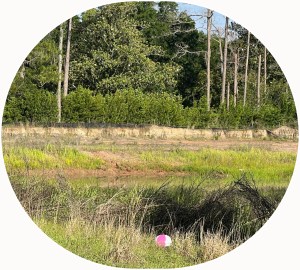
One of the messes in the common areas that pointed to the Weede family was the indoor pool area.  It became messier with a sickening overload of beach balls, floats, and tiny plastic toys sitting at the bottom of the pool that they left, as if the pool area was theirs alone.  They wouldn’t clean up their possessions.  Instead, they left their things for other residents to trip over.  Moreover, that family complained a lot when the pool was in repair.  La-di-da.  It even got to a point that they left their pool toys all over the common property, and one beach ball made it to the pond area, and it’s been sitting there for months upon months.  There it is in the lower portion of this photograph, in all its pink and white glory:
In the end, the Weedes’ presence swelled with their toys, tricycles, sand shovels, dolls, and baseball bats that hung like spores in the common areas, tucked around the buildings, in the grass, and by the pool.  They were a reminder that some households don’t just live in a building; they colonize it and make it unpleasant for the other owners who respect neighbors.  Yet, at Sage Pointe, the Weedes were not merely neighbors.  They were an atmosphere of eccentric proportions that took over and conquered.

It’s something to behold when people have so many possessions that they don’t miss them when they are scattered hither and yon.  That’s the clue when gluttony becomes the norm.
 

Cutting the Mustard.

A Lesson in Gluttony and Control.

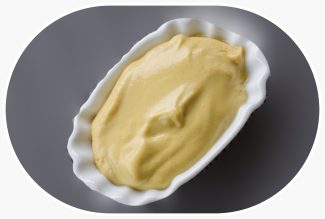
Finally, there is only French’s® yellow and Gulden’s® brown on my pantry shelf.

Once upon a time, that space was also shared – packed, in fact – with small jars holding other variations: champagne, chipotle, curry, honey, jalapeno, siracha, Dijon, . . .

Then, one day, I said aloud, “That’s it!  No more of these yuppified wannabees!”

And Lo!  The clouds parted and the sun came out.  Best Friend assented my exclamation with a “Hear!  Hear!”

We do like mustard.  It was easy to pick up a small jar of something a little different when we stopped by our local winery.  What’s a two-ounce jar of champagne honey mustard?  It didn’t take up much refrigerator shelf space along with the other six or seven two-ounce jars.

Yet, that one day, I had enough.  Those “specialty” mustards began tasting pretty much alike.  There wasn’t anything special about them anymore, except perhaps their unusually shaped jars that really had no further purpose for me after the last bit of mustard was scraped from the sides.

I was throwing money out the proverbial window.  And for what?  To feel like we were indulging in something special or upper class?

Pfffft.  It was a waste.  We said right then and there that those types of mustards won’t darken our doors again.  From then on, it will be a bottle of yellow, a bottle of brown, and a jar of Dijon.  That’s all!  No more yuppy mustard, as we call it.  No more fancy-this and fancy-that.

Along the same lines, in fact, the equivalent goes for fancy horseradish – I have a bottle of siracha horseradish that I bought a few weeks ago from a mom-and-pop grocery store in a neighboring town.  Is it anything special?  No, not really.  It’s really not what I expected; it’s not any hotter or spicier than regular horseradish, and it has a strange, sweet background taste to it.  I could kick myself for not reading the ingredients list better, because this bottle of weirdness has corn syrup in it.  (We’re cutting out corn syrup from our diet).  So, if I want the kick that siracha gives to my bowl of pho or broiled chicken or vegetable stir fry, I can get the siracha bottle from the refrigerator and squeeze a shot or two on my plate.  If I want horseradish, I can make my own fresh or buy a jar of straight horseradish.  I don’t need an odd yuppie horseradish-siracha concoction. Keeping it simple, silly!

So, we’re cutting the mustard.  We’re keeping it unpretentious.  Now on the refrigerator shelf sits a container of yellow, a bottle of brown, and there is a space for Dijon because I need that specifically for making Steak Diane.  Otherwise, any other types of strange mustards will remain on the store and winery shelves, available for other shoppers and connoisseurs to fill up their refrigerators and sate their taste buds with frou-frou table mustards.

It’s minimalism for us now.

The Age of Adonis (Part 3).

Part 3 of 3:  The Middle Distance.

There is a peculiar vantage point one gains simply by living in close proximity to other human beings.  Not close enough to know their secrets, but close enough to witness their habits; their triumphs, their peculiarities, their kindness, their small vanities, their authenticity, and quieter graces.  It is the view from the middle distance, where comedy and clarity often arrive hand‑in‑hand.

From this vantage point, I have watched our neighborhood Adonis swell into his mythic proportions, strutting through the hallways and on the neighborhood sidewalks like a man auditioning for a protein‑powder commercial.  His life is lived in bold, glossy strokes of sweat, swagger, and spectacle.  He found the easy way in life to make a dollar, becoming a grifter front and center on the unholy stage of a community fellowship group, sermonizing under the guise of praises and blessings peppered within his readings of scripture verses found in a distorted Bible.  He is the sort of person who seems to believe that if he flexes hard enough – whether it is flexing by quoting scripture or flexing muscles – the world will mistake it for virtue.  At the same time, he soaks in the adulation and attention as one would with water from the River Jordan.

And then, from the same vantage point, I have watched the quiet ones; the door‑holders, the plant‑waterers, the hallway‑softeners moving through the building with a gentleness that neither asks nor demands anything in return.  Their lives are lived in gentle lowercase letters, steady and unadorned.  They are not trying to be noticed, which is precisely why they are.

Modern life, for all its noise, has a way of revealing character in the smallest of moments.  The man who performs goodness loudly often performs it only for the applause and attention.  The man who waters the begonias when no one is looking is not performing at all.  He is simply and unobtrusively being who he is.

Discernment, I’ve learned, is not about judging people harshly.  It’s about seeing clearly and recognizing the difference between shine and substance, between the man who builds his body like an Old Testament golden monument and the neighbor who quietly builds a life of decency.  Humility, too, is not a grand gesture.  It is the quiet refusal to make oneself the center of every hallway and fellowship stage.  To learn what not to become is one of the great lessons of life.

And what about the comedy of modernity?  It’s everywhere.  It’s in the man who cannot lower his arms because his torso has become a personal billboard.  It’s in the fluorescent lights catching a thousand sequins on Cowgirl Betty’s jacket in the middle of a sunny day.  It’s in the way we all, at one point or another, take ourselves far too seriously.

But the deeper comedy is the one that makes you smile long after the moment has passed.  It is this: the people who most want to be admired rarely are, and the people who never think about admiration often end up holding the whole place together.

In the middle distance, the truth becomes clear.  Strength is not measured in inches of bicep or the girth of one’s chest.  Beauty is not measured in lumens of sparkle.  Virtue, the real kind, is almost always quiet enough to miss if you’re not paying attention.

But once you see it, you start noticing it everywhere.

This is the final chapter of three parts.

The Age of Adonis (Part 1)

Part 1 of 3:  Reflections on Vanity, Virtue, and the Modern Parade

He was the sort of man who made a living preaching The Word while somehow managing to sidestep most of its demands.  You could see it in the way he carried himself; earnest on the surface, but with a hollowness underneath, like a sermon missing its last page.

When I first met him, he was almost aggressively unremarkable: small, soft around the middle, a crew cut that looked like it had been administered by someone in a hurry, and some type of cologne that would gag a maggot.  He told me he had left the Church and was now preaching at a non‑denominational fellowship down the road.  He quoted Scripture with the enthusiasm of someone who had just discovered the footnotes and wanted everyone to know and be impressed.  Truthfully, it felt less like devotion and more like a performance of mental gymnastics meant to impress.  They didn’t.

In our brief conversations, he mentioned he was a former drug user, now clean, and that he was “still learning” and had “a long way to go” in understanding The Word.  That part, at least, I believed.

But then something shifted.

Slowly, his upper body began to expand.  It was first subtly, then alarmingly.  I would see him at the neighborhood gym, or returning from it, sweat pouring off him in rivulets that perfumed the condominium hallways with a scent that could only be described as fusty.  Other days, I’d spot him leaving Atomic Health Club in town, towels slung over his shoulder, his wet T‑shirt clinging to him like a second skin.  He would leap into his sports car with the flourish of a man starring in his own music video and drive off like a bolt out of the blue.

By summer, the transformation seemed complete.  One afternoon, he and his family walked down the hallway on their way to the swimming pool. “Walked” is generous—he lumbered, unable to lower his arms fully because his torso had grown to mythic proportions.  He wore only baggy shorts (I cannot call them trunks), his thick thighs rubbing together and his calves looking like chicken legs.  It looked like it hurt him to move his legs, and for that moment I felt sorry for him.  His pre‑tween daughter wore a bikini so revealing it made me blink twice in embarrassment.  His wife and son, ironically, were dressed modestly befitting a church picnic.

His upper body had become enormous, his thighs still pronounced, his calves still comically thin.  He reminded me of a Greek statue carved by an artist who ran out of marble halfway through.  It was unsettling, the kind of physique that makes you instinctively step aside in case it topples or explodes.

He strutted through the building with the air of a man fishing for admiration, or perhaps for something more.  Someone once told me that people who leave one addiction often find another to replace the high.  Maybe this was that; maybe it wasn’t.  I’m not his confessor; I can only pray for him.

What I do know is this: the greater his muscles grew, the quieter his preaching rang.  There was a disconnect between the man he proclaimed himself to be and the man he was becoming, between the humility of the Gospel and the vanity of the mirror.

And perhaps that is the real caution of the Age of Adonis: when the body becomes the altar, the soul is left without a place to kneel and worship the one true God.

Part 2 will be published on April 16, 2026.


Website Built with WordPress.com.

Up ↑