

The Poverty of Perpetual Anger.

There is a particular sadness in watching people who live in a constant state of anger, and I see this quite a lot in my neighborhood, and especially since 2020.  Their anger is not the righteous anger that rises to defend the vulnerable, but the chronic, simmering kind; the kind that becomes a personality, a worldview, a permanent narrowing of the soul.  Some of these people turn ugly and violent when they are cordially greeted by neighbors.  These are people who treat every encounter as a contest, every disagreement as a threat, every difference as a personal insult.  Perhaps they believe they are defending themselves, but in truth they are defending the walls that imprison them.

Anger becomes their only vocabulary.  They speak it fluently, instinctively, even proudly, and peppered heavily with vulgar and filthy words.  But beneath that lies a deep poverty of spirit.  A person who must always be angry and offensive is a person who has forgotten how to be free and kind.

The tragedy is not merely that they harm others—though they do.  The deeper tragedy is what they lose within themselves without realizing it.

  • They lose the ability to be surprised by goodness.
  • They lose the capacity for joy that comes from generosity.
  • They lose the peace that only humility can give.
  • They lose the richness of a larger world than their own reflection.

They trade all of this for the brittle satisfaction of being “right” and boorish, even when that “rightness” isolates them.  They probably do not realize that the fortress they build to keep others out is the same fortress that keeps them in.

My sadness for them is not schmaltzy.  It is not the soft sadness of pity.  It is the sharper sadness that comes from recognizing wasted possibility.  These are people who could be expansive, curious, generous, a positive addition to the neighborhood, but instead they choose the cramped rooms of anger and rejection.  They choose to live in a world too small for any soul.  It is as though they are possessed by demons.

A life fueled by anger cannot lead to peace.  A heart closed to others cannot experience love.  A mind that rejects difference cannot grow.  They may cling to their fury and their narrowness as if these things protect them, but in the end, they protect nothing.  They only ensure that the person holding them remains untouched by the very things that make life worth living.
When the Day Grows Weightless.

Evening had only just begun to gather when we stepped out of the house, leaving behind the familiar busyness of the day.  The sky was already settling into that muted greyish‑blue that feels less like a color and more like a threshold of an in‑between hour when the world loosens its grip and invites you to breathe unworriedly.

We drove to the historic part of town, where old brick and weathered wood seem to remember more than they reveal, and where the streets narrow as if encouraging you to slow down.

We parked near the waterfront at Twilight Bay.  I gathered my sweater around me and took a deep breath; the salty air and the freshness of the evening made me forget the world.  We wandered toward a small bench built for two, its placement so perfect it felt almost intentional, as though someone long ago had known that people would come here seeking a moment of quiet.  The lazy breezes carried a crisp coolness, brushing away the last warmth of the day.  As we settled into the bench, the sun began its slow, deliberate descent; that an unhurried surrender that painted the bay in streaks of rose, amber, and fading gold.

Above us, pelicans glided in near‑silence, their wings steady and sure.  They usually lingered on the lawns or sidewalks nearby, waiting for a passerby to drop a morsel, but tonight they moved with a different kind of intention.  Their silhouettes drifted toward the boats anchored in the harbor, as though they sensed a more certain feast waiting among the sailors.  Watching them, it was hard not to feel that even the birds understood something about seeking what truly nourishes rather than what merely distracts.

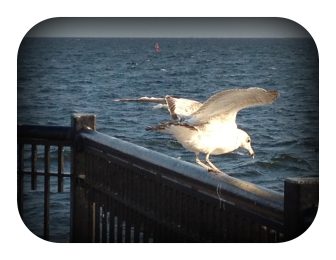
A stout gull perched on the railing before us, facing the sunset with a composure that felt almost ceremonial.  Its white feathers caught the last light, turning the bird into a soft, luminous creature.  We admired its quiet splendor as I took out my camera.  And wouldn’t you know it?  Just as I lifted the camera and clicked the shutter, the sea gull opened its wings in a single, fluid motion and rose into the air.  The moment felt like a small benediction; unplanned, unearned, yet somehow perfectly timed.

Far out in the bay, a solitary sailboat rocked gently, its silhouette dark against the shimmering water.  It drifted without urgency, as though content simply to exist in the cradle of the evening.  There was something instructive in its stillness: a reminder that not every movement must be purposeful, not every moment must be filled willy-nilly.

Sitting there, it became clear that serenity is not something we manufacture; it is something we allow.  The bay freely offered its calmness, asking only that we pause long enough to receive and embrace it.  In a world that often demands speed, noise, and constant reaction, this quiet corner felt like a small act of resistance, a place where the soul could unclench, relax, and accept a bit of freedom.

The twilight deepened, and with it came a sense of interior spaciousness, the kind that arrives only when the world grows quiet enough for the heart to hear itself again.  A quiet truth settled over us, reminding us that stillness is its own kind of blessing.


Website Built with WordPress.com.

Up ↑