
Phony, Even Amongst Themselves.

I often wonder what makes certain people behave one way in public and quite another when they believe no one is watching.  It’s a small mystery of human nature, but every now and then, a particular encounter forces me to look at it more closely.

The Stankles were just such a family.

Individually, each member was curt at best and openly rude at worst.  When I passed them alone in the lobby, they wouldn’t greet me, wouldn’t hold a door, wouldn’t even muster the basic civility expected of neighbors.  Adonis Stankle once sneered outright at the ashes on my forehead on Ash Wednesday, as if the sign of repentance were a personal affront to him.  Which, maybe it was.  He left the Church because of some falling out with his own father and moved to a non-denominational Protestant sect.  That’s what he said.

But the moment another Stankle appeared beside them, the transformation was instantaneous.  Suddenly it was All Christian, All the Time: doors held open, cheerful greetings, syrupy small talk, and enough forced sunshine to blind a person.  As a group, they radiated a kind of performative wholesomeness.  Alone, each one reverted to something far less pleasant.

What made the contrast even stranger was that Adonis, the patriarch, fancied himself a weekend preacher.  Every Sunday he mounted his little stage of his community building of self-importance, reading from his community’s version of Scripture and occasionally dunking someone in the waters of baptism.  Meanwhile, his children vandalized parts of the building and stashed garbage in the common-area closets.  His wife, when encountered alone, was as prickly and uncommunicative as a person could be.

It was the oldest stereotype in the book: the preacher’s family who shines only when the lights are on.  The more I observed them, the more I wondered whether the righteousness they displayed in public was merely a costume; one they donned for applause and shed the moment the audience disappeared.

It sure seemed that way.

 

The Sheriff of Decibels:  The Man Who Heard Too Much

A Lesson in Consideration.

I once wrote about the Sheriff of Decibels, a neighbor from a high‑rise condominium where keeping to oneself was the unofficial building policy.  Everyone did keep to themselves, and life was blissfully uneventful, until the night he, Mr. Wigg, called to inform me that my television was “too loud” and preventing him from sleeping.

Now, I had been living at that condominium for years; he was living there long before I showed up on the scene.  So, this was a surprise out of nowhere.

That phone call became the overture to a recurring performance, a kind of neighborhood opera in which he played both the aggrieved victim and the self‑appointed enforcer of silence.  After a few of these episodes, I began to wonder whether sound was truly traveling through the walls or whether he simply enjoyed the adrenaline rush of a well‑timed complaint.  After all, the room with my television didn’t even share a wall with his bedroom; it butted up against his butler’s pantry.  And I hadn’t turned on that television for months by this time.

The irony was rich: I could hear his television, too, but only when I passed his front door.  Talk shows, game shows, the full audio spectrum.  Yet it never occurred to me to call him and issue a noise citation.  I assumed he was just living his life, the way people do when they choose communal living over a cabin in the woods.

Then one afternoon, as I walked down the common hallway, his door cracked open an inch.  “Pssst!  I can hear sounds from your condo,” he whispered, as if delivering classified intelligence.

I turned to look through the sliver of darkness.  Only Mr. Wigg’s lips were visible, and the darkness behind him was black and infinite.  I told him flatly that nothing was playing and kept walking.  For a moment, I wondered if he stood in his butler’s pantry with a cup pressed to the wall, listening for enemy war plans.  The image made me laugh.

There’s a particular fatigue that comes from dealing with neighbors who are both hypersensitive and oblivious to their own habits.  It’s like being lectured on etiquette by someone chewing with their mouth open.  You could point it out, but it would never land.

I concluded that the issue lay not with me but with his imagination, or his hearing aids, or him pressing his ear against our common wall.  Who knows?  I kept living my life at a normal volume, unbothered.

Then one day, everything came to light.  When my best friend was walking down the hallway coming back from the garbage room, he bumped into Mr. Wigg.  The spoke awhile, and the true of this “noise” matter was discovered.  It appeared that we and Mr. Wigg have the same brand and model of television.  Through the wonders of modern technology, the sounds from our television come through his speakers.  We have heard his television sound come through our speakers, too.  And what about our television turning off by itself?  Well, it also is apparent that his remote and our remote affect the other’s sets.

Therefore, isn’t it better to find the source of a problem before claiming someone of malfeasance?  It could all be an innocent technology glitch.  Mr. Wigg wouldn’t have been aggravated, and I wouldn’t think of the situation as silly.


Loose Trash and Looser Rules.

When I lived at the Sage Pointe Condominiums, the truth was simple: there were no real rules.  The Declaration contained only a handful of vague guidelines, none of which carried penalties, financial or otherwise.  In practice, nothing had any teeth; no bite.

What we did have was the Infractions Team, a small group of older ladies who enforced whatever they personally disliked.  If something offended their sensibilities, it instantly became a “rule,” and the offending neighbor was told to cease and desist.  Their grievances ranged from the trivial to the absurd, such as declaring certain bumper stickers on residents’ cars to be violations simply because the messages clashed with their unholy beliefs.  Those errant residents were then threatened with legal action.

Meanwhile, these same enforcers stored their own holiday decorations, bicycles, and medical equipment in the common-area closets with complete impunity. They walked their dogs off the leash.  They grilled pork chops on their balconies with open flames.  They filled staircases with their potted plants.  No reprimands.  No consequences.  No surprise.  It was the classic Rules for Thee and Not for Me dynamic, and everyone knew it.

One of the few written directives concerned garbage disposal.  For years, printed signs were taped to the garbage-room doors in the underground garage.  They instructed residents to place all trash in securely tied plastic bags and to dispose of furniture and large items privately, never in the dumpsters.

As the buildings filled with more residents (there was an ebb and flow with the population), the dumpsters began overflowing just two days after pickup.  At a homeowners’ association meeting, a member of the Care and Upkeep Team scolded the community for tossing unbagged trash and furniture into the dumpsters.  The remarks were recorded in the official minutes.

A couple of weeks later, I went down to throw out my own securely bagged garbage.  I glanced into the dumpster, and there it was.  A mountain of loose junk: files, hanging folders, workbooks, an American flag, Navy memorabilia, and other unbagged débris.  Because the book titles were visible, it was unmistakably the personal clutter of the very same Care and Upkeep Team member who had lectured everyone else about dumping unbagged garbage!

It was a perfect illustration of the deleterious culture at Sage Pointe: rules for thee and not for me.  Others were expected to follow the posted guidelines.  Certain individuals, however, exempted themselves entirely.

They were special!


Another Whiff that Crossed the Line.

And then there was the unmistakable contribution of The Weede Family, whose fusty skunk aroma drifted through the hallways with the determination of a creature lazily seeking freedom.

I have lived in buildings that had friendly doormen and fresh flowers in the lobby, and truly dedicated cleaning crews that cleaned and deodorized a couple times a week.  When I lived in one of those large mid‑rise buildings, the kind with long hallways, welcoming vestibules, perpetually humming vents, there was a cast of neighbors who could each produce their own documentary, for everyone had such pleasantly interesting lives to tell.

However, when I lived at Sage Pointe Condominiums, there were odors of marijuana, tobacco, and perfume that were thickly layered and ever evolving on every floor and in the lobby.  That condominium association was immensely different than all the rest.  Life there was, indeed, never dull, particularly if you had a sensitive nose or didn’t care how dirty the common areas were.  Speaking of the common areas, the walls were always dirty with oil or Cheetos® dust, the common hall carpets were never cleaned, the lobby walls were a patchwork of rinky dink Spackle® repairs and paint that never matched.  “They” never wanted to repaint the entire walls the proper way.

In today’s essay, I’m introducing you to one of the more fusty aromatic residents, The Weede Family.

They lived on my floor and at the far end.  One would never think that the odors from their wing would reach way down to my wing, but they did.  Whenever I opened my front door or stepped off the elevator, I braced myself.  I never knew what stench or invisible cloud would greet me, or what new olfactory assault would come barreling toward my unsuspecting nose.

The fetid odors were unmistakably marijuana.  Not just one kind, but several, and one would never know from one day to the next what strain they’d be smoking.  The worst was the kind that smelled like dead, rotting skunk.  Sometimes that stench was mixed with cheap perfume, and it was enough to suffocate a maggot.  Truthfully, I was surprised I never smelled it in my own condominium unit, but only out in the hallway.

By the time I learned to recognize their specific bouquet and the shifting medley of strains that was each more pungent than the last, I also learned something else: in a building like ours was, no door was ever fully closed, no hallway ever truly empty.  Scents travelled like rumors as they drifted, settled, and rose again when you least expected it.  The Weede Family managed to turn our peaceful corridor into a living, breathing testament to that truth.  Their skunky, dank fog became part of the building’s strange ecology, and a reminder that even in the most ordinary mid‑rise building, the air itself can tell stories you’d never believe unless you smelled them yourself.


The Mark of Mordechi.

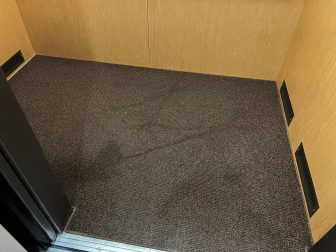
There were always dirty spots on the hallway carpets and in the elevators when I lived at Sage Pointe.  At first glance, they looked like the usual suspects, perhaps greasy take‑out containers leaking through flimsy bags, or perhaps the aftermath of a dog with poor timing.  Whatever their origin, the stains remained year after year after year, since no one on the board of directors ever bothered to call a carpet‑cleaning company to shampoo the carpets.

One weekend, though, someone obviously made an effort.  A sharp smell of Resolve® or Shout® hung in the hallways, proof that some anonymous soul had tried to scrub away the blotches.  Whoever it was deserved a medal for attempting to keep the place somewhat presentable.

Then came the Saturday afternoon when I stood waiting for the elevator to reach my floor.  At last, the doors slid open, and there stood Maddee and her younger brother, Mordechi, dripping from the pool and armed with their usual assortment of floaties and bottles.  Just as the doors parted, I caught Maddee in mid‑swoop, giving her water bottle a final flourish and spraying the elevator carpet.  When I looked down, I saw she had left a large, wet “M” beside the other permanent stains.  She and her brother stepped out quickly, their faces tight with guilt and silence.

I greeted them anyway, asked how they were. “How you doing?” I asked.  Maddee’s cheeks flushed deep crimson, and she stammered and babbled through a jumble of half‑formed words as she tripped over her tongue.  She knew that I knew.

The next morning, more than twelve hours later, I rode the elevator again.  The wet “M” was still there.  If it had been water, it would have evaporated long before.  Whatever she’d squirted (soda? juice? suntan lotion?) had soaked in and stayed put.  It’s still there to this day.

Funny, isn’t it, how the Stankle kids, the offspring of Adonis the preacher man and his aromatic wife, aren’t always the paragons one might expect.  And the kids weren’t toddlers; at the time this happened she was about eleven, he was about nine.  Both were old enough to know better and old enough to choose differently.  After all, their father preached it every Sunday and Wednesday on stage.

In a condominium association like Sage Pointe, the carpets in every building told the truth long before the residents did.  Every stain, every spill, every careless squirt from a child’s bottle became part of the story we all had to live with.

Courtesy, like cleanliness, is a shared responsibility.  It’s one that begins with small choices made when no one is supposed to be watching.  And yet, as those lingering marks remind us, someone always is watching, even if it’s only God.


Stench in the Shadows.

In the condominium association where I lived once upon a time, there was a strange occurrence that only a brave resident could resolve.  This is the true story.

The overstuffed garbage bags appeared twice weekly in the broom closet on the fifth floor of the condominium building.

What brought this to the attention of the residents was the overpowering stench of rotting foods in the bags.

On a Saturday morning, Miss Wanda, the bravest of the fifth-floor residents, had enough of the reek and marched to the broom closet.  Several residents followed her, for they wanted to be in on the revelation.  Wanda opened the door, and there it was: an overstuffed Hefty® bag emitting a stench that would knock a skunk off his beam.

Wanda took one of the bags and opened it up.  Everyone around her jumped back and held their noses.

“It smells like death,” Old Man Fontane gasped.  “Death on a plate of rotted sardines.”

“At least!” gagged Issac Brenner.  “It smells worse than my ex-wife’s armpits after a sweaty walk in the park.  I’d know that stench anywhere.  Barf!”

“Hoo-eee, Lordy!”  Mrs. Chisa Cooke walked away while holding her nose.  “Y’all enjoy.  I’m headed off to watch Julia reruns on my brand new television.”

Bravely, Miss Wanda dug into the garbage bag.  Slimy beet greens, a moldly banana, empty cartons, and paper brochures from the Poconos greeted her.  She dug around until she saw an envelope.  She reached for it with two fingers.

“Ah!  Well.”  She examined the address.  “Ah ha!  It’s from that brood across the hall from me.  I’ll talk to them.”  The neighbors nodded their heads and a few just whispered, “Ooo!” and “Yeah.”

Miss Wanda knocked on the Stankles’ door.  After talking with the grandmama, neighbors could hear the two women laughing before Miss Wanda returned to her condominium.

“So who did it?” Mrs. Chisa Cooke asked the next day in the laundry room.

“Oh, it was her youngest grandbaby, Tristane.  Do you know that ten-year-old is afraid of the dark, so he just tosses the garbage bags in the broom closet and runs back home!  His parents never check to see if the boy is doin’ his errands right.””


Elevator Encounter.

It was Monday evening in March several years ago, Saint Patrick’s Day in fact, when I lived at Sage Pointe and had the weirdest encounter at the elevator.  It was the kind of evening that felt like it had already overstayed its welcome with humidity, the sun nearly set below the horizon, and the atmosphere vaguely resentful overall.  The evening just didn’t feel right.  I had some business to attend to on the first floor of my condominium building.  It wasn’t anything dramatic; just a quick look-see on a neighbor’s wreath on the door.  Once that was done, I turned back toward the elevator, ready to ascend to the relative peace of my penthouse suite.

The elevator dinged open with its usual lack of enthusiasm.  Out stepped the dog walker who was a lean, overworked man with the expression of someone who’d long ago stopped pretending to enjoy his job.  He was wrangling two dogs that week: a jittery black and white shih-tzu dogs, one with a Napoleon syndrome and the other who looked like he’d seen too much in life.  They belong to the renter, “Princess,” we all called her.  Anyway, behind the dog walker emerged a disheveled woman who could only be described as a walking cautionary tale.

She was large, loud, and chaotic in every sense.  Her hair was a brittle, bottle-blonde explosion of stringy straw, unbrushed and defying gravity, as if she’d just lost a fight with the town’s stray cat in an electric storm.  Her clothes hung off her like they’d given up trying to flatter her shape, and her arms were crammed full with an assortment of objects: papers, a purse that had seen better decades, and a large bag that looked like it had been repurposed from a deflated beanbag chair.

Before I could step aside, she lunged forward, thrusting her face into mine with the urgency of someone trying to solve a crime in real time.

“146—Eight?  148?  148?” she barked, her breath a cocktail of tobacco, menthol, and desperation.

I blinked.  I had no idea what she was babbling about.  Was it a code?  A unit number?  A cry for help?

“148?” she repeated right in my face, louder this time, as if volume might unlock my comprehension.

“Umm—” I managed, instinctively leaning back, trying to create space between her and my personal bubble, which she had already detonated.

The dog walker, sensing my confusion and her unraveling, stepped in like a reluctant mediator.

“Here,” he said, gesturing down the hallway and beginning to walk, the two mutts trailing behind him like reluctant furry witnesses.  “I’ll help you get there.”

I didn’t wait for the encore.  I slipped into the elevator, pressed the button for my floor, and let the doors close on whatever that was.  The ride up felt like a small victory.  Quiet, controlled, and blessedly devoid of oddball mystery women and their numerical riddles.


Smoke, Scrape, Yell, Repeat.

A Lesson Neighbor Consideration.

After writing “The Sheriff of Decibels,” regarding the whole “your TV is too loud” saga with Mr. Wigg, the neighbor who might have been hearing phantom sounds, I thought I had earned a brief intermission in the neighborhood drama, but then it reminded me of one of the downstairs neighbors I had once, and those thoughts led to me think of a whole different angle.  Life in a condominium is basically a rotating cast of social challenges, and the next act began downstairs.

I lived in a condominium where one of my downstairs neighbors used her balcony like it was her personal broadcasting studio.  Whenever she had company, the visitors were always on the sidewalk below.  Their conversations rose straight up.  I didn’t even have to try to overhear; the dialogue arrived fully formed, projected upward with the confidence of someone who believed the entire building was her audience.  If she ever decided to start a podcast, she wouldn’t need equipment.  She already had the lungs for it.

Another neighbor was forever loud on her cell phone.  One afternoon, I heard her give out her bank account number, a passcode, and the balance.  Wow.

Then there’s the patio furniture.  There is a neighbor who, every time she shifts a chair on her balcony, it sounds like she’s dragging a cast-iron park bench across a stone floor.  I’ve heard less noise from actual construction sites.

There was the cigarette smoke from a cheap brand yet another neighbor probably bought by the truckload.  It drifted upward in slow, dramatic spirals, and somehow it slipped into my condo like it had a key.  One moment I’m enjoying fresh air; the next, my living room and kitchen smelled like a casino buffet circa 1960.  It wasn’t ideal, but I learned to adapt since the odor didn’t last more than a half hour or so.

But here’s the important part: I didn’t complain.  Not ever.  Not a text, not a note, not even a pointed throat-clear over the balcony railing.  Why?  Because this was life in a building full of people.  They talked loudly.  They scraped furniture.  They smoked.  They lived.  And unless someone was hosting a demolition derby in their living room, I tolerated the occasional disturbances.

Besides, after the Sheriff of Decibels dealings, I’ve developed a new appreciation for not becoming That Neighbor.  If I ever feel tempted to pick up the phone and lodge a complaint, I remember how it feels to be scolded for noises that may or may not exist.  It’s an excellent deterrent.

So, I let the balcony monologues rise, let the furniture screech across the concrete, let the cigarette smoke drift out and upward like a weather pattern.  I breathed, I adjusted, I moved on.  Because in the grand, chaotic symphony of condo living, sometimes the most intelligent thing you can do is simply not add your own instrument to the noise.

I just laughed it all off.


The Age of Adonis (Part 2)

Part 2 of 3:  The Quiet Virtues

Not long after watching the rise of our neighborhood Adonis — the sweat, the swagger, the ever‑expanding circumference of his upper body — I began noticing something else in the building.  Something smaller, quieter, and far easier to overlook.

It started with the older gentleman on the fifth floor, the one who always carries a canvas tote bag and walks with a slight shuffle.  I once saw him pause in the lobby to hold the door for a mother wrangling a stroller and two grocery bags.  He didn’t say much. He just nodded, smiled, and waited until she was safely inside.  No flexing.  No performance.  Just a simple act of courtesy that didn’t require an audience.

Then there’s the woman down the hall who leaves small seasonal decorations on her door.  They aren’t elaborate, just a tiny flowery wreath or a quilted, hanging pumpkin door decoration.  She never announces them, never tries to impress anyone.  But somehow those little touches soften the whole hallway, as if she’s quietly reminding the rest of us that beauty doesn’t have to shout.

And of course, there’s the retired engineer who waters the courtyard plants when no one else remembers.  He doesn’t make speeches about community or stewardship.  He simply notices what needs doing and does it, his hands moving with the calm competence of someone who has spent a lifetime tending to things that grow slowly.

None of these people would ever call themselves virtuous.  They would laugh at the idea.  They are simply living their lives with a kind of unselfconscious decency that doesn’t demand or look for applause.

It struck me one afternoon, watching the engineer mist the begonias while Adonis strutted past, that quiet virtues are the ones that actually hold a place together.  Not the loud displays of strength or the curated personas, but the small, steady acts that ask for nothing in return.

The world has always had its Adonises; men who sculpt themselves into monuments and then wonder why no one bows.  But the world has also always had its quiet souls, the ones who keep the doors open, the plants alive, the hallways gentle.

And if I’m honest, it’s the quiet ones who make a neighborhood livable.  They are the ballast, the steadying weight, the reminder that goodness doesn’t need to be dramatic nor a showboat to be real.

In a culture obsessed with spectacle, the quiet virtues are almost radical these days.  They whisper instead of shout.  They build instead of pose.  They endure long after the muscles deflate and the spotlight moves on.

And perhaps that is the real miracle: that in a world full of noise, the softest lives are often the ones that speak the truth most clearly.

Part 3 will be published on April 18, 2026.

Website Built with WordPress.com.

Up ↑