
Another Whiff that Crossed the Line.

And then there was the unmistakable contribution of The Weede Family, whose fusty skunk aroma drifted through the hallways with the determination of a creature lazily seeking freedom.

I have lived in buildings that had friendly doormen and fresh flowers in the lobby, and truly dedicated cleaning crews that cleaned and deodorized a couple times a week.  When I lived in one of those large mid‑rise buildings, the kind with long hallways, welcoming vestibules, perpetually humming vents, there was a cast of neighbors who could each produce their own documentary, for everyone had such pleasantly interesting lives to tell.

However, when I lived at Sage Pointe Condominiums, there were odors of marijuana, tobacco, and perfume that were thickly layered and ever evolving on every floor and in the lobby.  That condominium association was immensely different than all the rest.  Life there was, indeed, never dull, particularly if you had a sensitive nose or didn’t care how dirty the common areas were.  Speaking of the common areas, the walls were always dirty with oil or Cheetos® dust, the common hall carpets were never cleaned, the lobby walls were a patchwork of rinky dink Spackle® repairs and paint that never matched.  “They” never wanted to repaint the entire walls the proper way.

In today’s essay, I’m introducing you to one of the more fusty aromatic residents, The Weede Family.

They lived on my floor and at the far end.  One would never think that the odors from their wing would reach way down to my wing, but they did.  Whenever I opened my front door or stepped off the elevator, I braced myself.  I never knew what stench or invisible cloud would greet me, or what new olfactory assault would come barreling toward my unsuspecting nose.

The fetid odors were unmistakably marijuana.  Not just one kind, but several, and one would never know from one day to the next what strain they’d be smoking.  The worst was the kind that smelled like dead, rotting skunk.  Sometimes that stench was mixed with cheap perfume, and it was enough to suffocate a maggot.  Truthfully, I was surprised I never smelled it in my own condominium unit, but only out in the hallway.

By the time I learned to recognize their specific bouquet and the shifting medley of strains that was each more pungent than the last, I also learned something else: in a building like ours was, no door was ever fully closed, no hallway ever truly empty.  Scents travelled like rumors as they drifted, settled, and rose again when you least expected it.  The Weede Family managed to turn our peaceful corridor into a living, breathing testament to that truth.  Their skunky, dank fog became part of the building’s strange ecology, and a reminder that even in the most ordinary mid‑rise building, the air itself can tell stories you’d never believe unless you smelled them yourself.



The Mark of Mordechi.

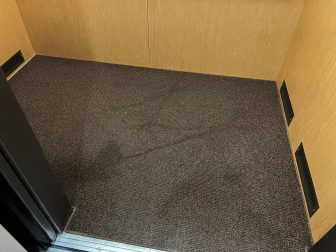
There were always dirty spots on the hallway carpets and in the elevators when I lived at Sage Pointe.  At first glance, they looked like the usual suspects, perhaps greasy take‑out containers leaking through flimsy bags, or perhaps the aftermath of a dog with poor timing.  Whatever their origin, the stains remained year after year after year, since no one on the board of directors ever bothered to call a carpet‑cleaning company to shampoo the carpets.

One weekend, though, someone obviously made an effort.  A sharp smell of Resolve® or Shout® hung in the hallways, proof that some anonymous soul had tried to scrub away the blotches.  Whoever it was deserved a medal for attempting to keep the place somewhat presentable.

Then came the Saturday afternoon when I stood waiting for the elevator to reach my floor.  At last, the doors slid open, and there stood Maddee and her younger brother, Mordechi, dripping from the pool and armed with their usual assortment of floaties and bottles.  Just as the doors parted, I caught Maddee in mid‑swoop, giving her water bottle a final flourish and spraying the elevator carpet.  When I looked down, I saw she had left a large, wet “M” beside the other permanent stains.  She and her brother stepped out quickly, their faces tight with guilt and silence.

I greeted them anyway, asked how they were. “How you doing?” I asked.  Maddee’s cheeks flushed deep crimson, and she stammered and babbled through a jumble of half‑formed words as she tripped over her tongue.  She knew that I knew.

The next morning, more than twelve hours later, I rode the elevator again.  The wet “M” was still there.  If it had been water, it would have evaporated long before.  Whatever she’d squirted (soda? juice? suntan lotion?) had soaked in and stayed put.  It’s still there to this day.

Funny, isn’t it, how the Stankle kids, the offspring of Adonis the preacher man and his aromatic wife, aren’t always the paragons one might expect.  And the kids weren’t toddlers; at the time this happened she was about eleven, he was about nine.  Both were old enough to know better and old enough to choose differently.  After all, their father preached it every Sunday and Wednesday on stage.

In a condominium association like Sage Pointe, the carpets in every building told the truth long before the residents did.  Every stain, every spill, every careless squirt from a child’s bottle became part of the story we all had to live with.

Courtesy, like cleanliness, is a shared responsibility.  It’s one that begins with small choices made when no one is supposed to be watching.  And yet, as those lingering marks remind us, someone always is watching, even if it’s only God.


Not-So-Sweet Tarts, and When No One’s Minding.

A Lesson in Modesty.

In a lot of areas around the country, this weekend marks the opening of public swimming pools, so dig out your floating devices and the skimpiest swimwear you can find.  This story comes from a time when I lived in a condominium with swimming pools, a wading pool, a cedar-lined steam room, and all the inconsiderations you can imagine.

The elevator car came to a stop on the lobby floor.  The doors slid open, and I was ready to step out, until I froze mid-step.  What made me pause were the three young women standing directly in front of me, momentarily blocking my path, dressed in barely-there bikinis and entirely unbothered by their own near‑nakedness in a public hallway.

They were college‑age visitors, laughing and carefree, accompanied by one of the downstairs middle‑aged neighbors who was wrapped in a thick beach robe.  The trio of girls, I found out later, spent the weekend coming and going, and the next day I saw them again, heading down the back stairs toward the pool.  As those sweet tarts walked, their swimsuits shifted and rode up, leaving little to the imagination between the ripples of fat and even less to modesty, by cracky.

There was even a time in the dead heat of summer where it just happened that an older, senior-type crowd was having a get-together under the heat of the blazing sun.  A group of teenage girls in tiny bikinis made their way down the pool’s stairs, smirking and walking slow and seductively right in front and past the men.  The women were at another corner of the pool and appeared not to notice the bru-ha-ha.

Throughout the swimming season, the indoor pool area itself told the rest of the story.  In the corners were mounds of inflatable toys stacked so high they reached halfway up the walls.  Beach balls, float rings, plastic ducks, water pistols, and abandoned gadgets cluttered the water.  More than once, if you wanted to swim, you had to fish out stray and abandoned toys or dive to the bottom to retrieve whatever had been left behind.  Interestingly, the steam room was always left clean and uncluttered.

Yet, it was the renters and short‑term visitors who were the ones who mostly descended upon the pools and hot tub, and that’s where most of the disorder began and remained.  Sure, they enjoyed all of the amenities but had no real stake in the property, so there was little incentive to care for it.  And, truthfully, the same could be said for the owners who hosted these guests or rented out their units.  The result was the same: a shared space treated as disposable simply because it belonged to everyone and therefore, in their minds, to no one.

In the end, what unsettled me was more than the exposed full butt cheeks and almost-to-the-nipples cleavage, or the toys or even the noise, but the casual indifference that trailed behind them all.  A shared space only works when the people passing through it feel some measure of responsibility for what they touch and leave behind.  When they don’t, when visitors treat the place as a weekend playground and owners look the other way, the common areas slowly erode.  And standing there in the elevator doorway, watching another wave of guests drift toward the pool, I realized how quickly a condominium building can lose its hominess when too many people forget or just don’t bother to care for it.


Cutting Cardboard.

We had just ordered our meal, when a party of four was seated two tables from us.

Grind.  Grind.  Grind.

“Where is that sound coming from?” I asked Best Friend as he sipped his drink.  “It sounds like somebody cutting corrugated cardboard with a serrated bread knife.”

“What’s that?”

“I hear someone cutting corrugated cardboard with a serrated bread knife.  It’s that specific of a sound.  Listen.”

Grind.  Grind.  Grind.

“It’s the dog,” Best Friend nonchalantly quipped as he put down his drink.

“Whoa!” I whispered.  I leaned over a little bit to the left and looked past Best Friend’s shoulder.  Sure enough, at the table where the party of four sat, was a Yorkie on the man’s lap, chewing on food from the man’s plate and making a sound like somebody cutting corrugated cardboard with a serrated bread knife.  Then I witnessed the man put down one of those doggie pads on the floor and set the Yorkie on it, whereby Yorkie promptly did his business.  Everyone else at that table was oblivious and didn’t bat an eye.

Ewwww.

I am not a fan of dogs or any sort of animals in restaurants and stores.  I find it dirty, and it puts the question of health codes out there.  Service dogs are okay, but not “emotional service” or those “just because I can’t live two minutes without Fluffy” animals inside stores and especially restaurants.  Bleh.

One of the grocery store chains in our area put a stop to people bringing dogs or any animals into their stores, except for service animals.  I agree with that.  And, please, no dogs in grocery carts.  I saw that exact thing at one grocery store a couple years ago.  Where have those rear ends been?  I never saw anyone wash those grocery carts, either.

It’s so gross!


Hack, Steal, Swipe, and Other Modern Courtesies.

It’s the Language of Plunder, and it’s all the rage I’m talking about today.

Every so often, my thoughts drift toward the strange new definitions floating around in the modern lexicon.  It’s those little word fads that flare up, spread everywhere, and then vanish the moment a shinier bit of slang arrives.  A word fad, as I see it, is a piece of language used mindlessly, repeated without understanding, and destined for the linguistic landfill as soon as the next trend rolls in.

One of the most abused is hack.  We now have hair hacks, cooking hacks, travel hacks, security hacks, hacks for everything under the sun.   The word is slapped onto any tip, trick, or mildly useful suggestion.  Yet its true definitions include “gaining unauthorized access” and “cutting with heavy blows.”  Neither definition suggests something gentle, clever, or admirable.  Hack!

But instead of offering tips such as hair tips, security tips, cooking tips, we hack, hack, hack.  Take unauthorized access.  Grab and run.  Rip off.  Steal.

Which brings me to another disturbing phrase I hear far too often: “I’m going to steal that idea!”

Usually, it’s said when someone supposedly admires another person’s décor, recipe, style, or skill.  Once upon a time, we might have simply complimented the person.  We might even (brace yourself) have asked permission to borrow the idea.  However, courtesy is apparently passé these days.  Why ask when you can proudly announce your intention to steal from that person?

Why, indeed?  Hands up!  Hand it over!

So now everything is framed as theft: steal, swipe, take, hack.  Even admiration is expressed in The Language of Plunder.

It’s a small thing, perhaps, however, small things shape habits, and habits shape culture.  When our everyday speech defaults to the vocabulary of taking, it’s no wonder the world feels increasingly coarse, transactional, and grabby.

And yet, here we are.  This is the way of things now.

In the end, these little phrases are not harmless quirks of speech; they reveal how casually we treat one another.  When the language of theft becomes the language of admiration, something in our cultural posture shifts away from gratitude, away from courtesy, away from the simple dignity of asking.  Words shape habits, and habits shape the world we build together.  If we want a gentler world, perhaps we begin by speaking as though one is still possible.


Smoke, Scrape, Yell, Repeat.

A Lesson Neighbor Consideration.

After writing “The Sheriff of Decibels,” regarding the whole “your TV is too loud” saga with Mr. Wigg, the neighbor who might have been hearing phantom sounds, I thought I had earned a brief intermission in the neighborhood drama, but then it reminded me of one of the downstairs neighbors I had once, and those thoughts led to me think of a whole different angle.  Life in a condominium is basically a rotating cast of social challenges, and the next act began downstairs.

I lived in a condominium where one of my downstairs neighbors used her balcony like it was her personal broadcasting studio.  Whenever she had company, the visitors were always on the sidewalk below.  Their conversations rose straight up.  I didn’t even have to try to overhear; the dialogue arrived fully formed, projected upward with the confidence of someone who believed the entire building was her audience.  If she ever decided to start a podcast, she wouldn’t need equipment.  She already had the lungs for it.

Another neighbor was forever loud on her cell phone.  One afternoon, I heard her give out her bank account number, a passcode, and the balance.  Wow.

Then there’s the patio furniture.  There is a neighbor who, every time she shifts a chair on her balcony, it sounds like she’s dragging a cast-iron park bench across a stone floor.  I’ve heard less noise from actual construction sites.

There was the cigarette smoke from a cheap brand yet another neighbor probably bought by the truckload.  It drifted upward in slow, dramatic spirals, and somehow it slipped into my condo like it had a key.  One moment I’m enjoying fresh air; the next, my living room and kitchen smelled like a casino buffet circa 1960.  It wasn’t ideal, but I learned to adapt since the odor didn’t last more than a half hour or so.

But here’s the important part: I didn’t complain.  Not ever.  Not a text, not a note, not even a pointed throat-clear over the balcony railing.  Why?  Because this was life in a building full of people.  They talked loudly.  They scraped furniture.  They smoked.  They lived.  And unless someone was hosting a demolition derby in their living room, I tolerated the occasional disturbances.

Besides, after the Sheriff of Decibels dealings, I’ve developed a new appreciation for not becoming That Neighbor.  If I ever feel tempted to pick up the phone and lodge a complaint, I remember how it feels to be scolded for noises that may or may not exist.  It’s an excellent deterrent.

So, I let the balcony monologues rise, let the furniture screech across the concrete, let the cigarette smoke drift out and upward like a weather pattern.  I breathed, I adjusted, I moved on.  Because in the grand, chaotic symphony of condo living, sometimes the most intelligent thing you can do is simply not add your own instrument to the noise.

I just laughed it all off.


A Ministry of Mayhem.

Parents who do not teach their children to respect and obey actually prepare them for a life out of step with God’s Word and in step with the devils.

You might assume that a man styling himself a pastor would have a household that at least vaguely exhibits the teachings of Jesus.  You know, the kind of pastor who should be an example to society, a spiritual guide, a moral compass, and a weekly dispenser of authentic wisdom on the stage of his Fellowship Congregation.  You might even imagine that he’d model basic manners and modesty.

A long time ago, when I lived in a certain condominium, one such person paraded bare-chested in the condominium hallways and public sidewalks.  You’d probably would think that this “pastor” would’ve covered himself up and not parade around in public bare-chested.  By doing that, he was teaching his son well to do the same, which eventually happened, too.  As time when on, his pre-teen daughter was wearing low cut tops and belly-button-showing jeans and beachwear.

This particular family let their children throw out the family garbage, not through the garbage chute, but leave it hidden in the janitor’s closet until the odors compelled other residents to investigate.  The kids squirted soda or some sort of drink on the carpet in the elevator (I saw them do that just as the elevator door opened.)  If the parents double-checked their kids’ chores and where they were, they could’ve corrected them and set them on the right path.  Maybe.

Their children, old enough to know better, ran through the halls at all hours: dawn, mid‑afternoon, nearly midnight.  The thundering footsteps were so intense I occasionally wondered if the building had been repurposed as a training facility for buffalo stampedes.

And again, these were not toddlers.  These were pre‑teens, fully capable of understanding rules, boundaries, and the concept of “other people exist,” so be thoughtful!

The “pastor’s” wife, too, contributed to her own public ministry: it was an evangelization of scent so potent it could’ve knocked a person out.  It was so strong and long-lasting, it made the neighbors think she most likely applied the body lotions and colognes uncontrollably from head to toe.  Her cologne didn’t merely enter the hallways or elevator; it conquered, planted a flag, and dared anyone to challenge its sovereignty.  Her neighborliness went as far as waving at you with her arm behind her head, but never turning to face you and say, “hello.”

Maybe I’m all wet here; however, my thoughts always were that when a husband/father is a pastor of some wort, he guides his family on the path of holiness according to Jesus’ teachings and they all become a positive example to the neighborhood and to the world.  Yet, in that case I wrote about, they weren’t all that friendly, the kids were wild, and they sure solidified the neighbors’ opinions that a “pastor’s” family can be a shining example of what not to do.

In the end, it’s sad: a “pastor” who cannot shepherd his own household, a family whose public displays consists of hallway chaos, elevator dirtying, public undress, and overall disrespect towards neighbors.

But beneath all that sits a quieter truth.  When parents refuse to teach respect, discipline, and consideration, the world instead becomes their children’s classroom, and the lessons are rarely kind.  A household without order doesn’t just scandalize and inconvenience its neighbors; it forms a generation unprepared for the responsibilities, reverence, and self‑control that a faithful and respectable life requires.


The Age of Performed Identity.

How much of our lives have we spent trying to be something—or someone—we’re not?  It is one thing to pursue growth, to refine our character, and to enrich our inner life, yet it is quite another to adopt a false identity for the sake of impressing others, whether for money, status, or the fleeting approval of strangers, family, and acquaintances.

Lately, it seems that the art of pretending has become a widespread habit, a kind of cultural contagion.  Over the past decade especially, I’ve watched this phenomenon snowball.  It has become easier and fiendishly tempting to put on a polished façade while abandoning genuineness, humility, and empathy.  Social media, with its curated illusions and endless opportunities for self‑promotion and keyboard commandos, has been the chief purveyor of these false faces.

And how easy it is.

In a world moving at swift speed, the pressure to perform seems to be ceaseless.  Some people feel compelled to reinvent themselves for every audience, to appear more educated, more virtuous, more high class, more enlightened than they truly are.  Some people, unfortunately, strain to become the moral authority in every conversation, to project wisdom they have not earned, and to cloak their insecurity in a thin veil of false humility.  Some people invent and re-invent their live story continuously.

It must be exhausting.  From my vantage point, watching someone puff himself up by preaching from an imaginary pulpit, presenting himself as all‑knowing while sprinkling in counterfeit modesty, or looking down their nose at others, is a disheartening sight.  There is nothing admirable in self‑inflation or pretend self-deflation.  It does not elevate a person; it exposes him.  False humility serves only the ego.  It leaves no room to serve God, despite all their claims of “thanking God everyday” for such-and-such.  It comes across Pharisee-like when you know their true history and that they are putting on a public show.

Putting on an act for selfish gain is, at its core, a fabrication of the truth.  Duplicity demands constant maintenance, and after a while, there is so much maintenance that fabrication becomes sloppier and sloppier.  One must remember every false detail with perfect precision just to keep the fiction intact, and that’s the hard labor one has to do for a hollow reward in the prison of their mind’s fantasy.

It is far better to remember that the one thing you can do better than anyone else is to be yourself.  Of course, one could make the argument that being phony for some people is “being themselves.  Yet there is less work and stress to admit one’s true self and not make up stories to impress an audience.  Or in one case, I have seen one person who has shared his childhood as first “middle class,” then defined it as “not quite middle class,” to the sad Dickensian tale of “being poor.”  Is that the “fake it until you make it” mantra at work, or the pretend “rags to riches” story?  I won’t bother to hazard a guess.  All I can say is I have little regard for counterfeits.

The world does not need more people parroting platitudes or mimicking the latest persona.  It needs more of the original, the sincere, the unvarnished.  Pretending to be someone else is not only dishonest because it is truly a quiet betrayal of your own dignity.

As we step into another day, we should do so with sober eyes and clear hearts.  Remember who you really are beneath the noise and the pressure, and do not compromise that reality.  Be honest, be considerate, and be grounded in your principles.  Respect yourself and extend that respect to others.


Time Blindness.

Once upon a time, my spouse was the President of our condominium association.  He was the designated point‑man for every vendor, handyman, contractor, and the property manager.  And without fail, something out there seemed to decide that the exact moment we sit down to eat was the perfect time for someone to call him.

It didn’t matter when we ate:

11:00 AM?  Phone rings.

12:15 PM?  Phone rings.

4:45 PM?  Phone rings.

7:30 AM?  Phone rings, because apparently breakfast is also fair game, too.

It was as if people had a sixth sense for when a fork was about to touch a plate.

Even the other board and committee members who should have known better seemed to be compelled to call precisely when we were eating, and not all of these calls were emergencies, either.

Appointments were no better.  If someone was scheduled to arrive at 9:00 AM, they absolutely, without hesitation, called at 8:15 AM to announce:

“I’m here.”

Not “I’m on my way.”  Not “I’ll be there soon.”  No.  They were already standing outside like a time‑traveling courier from the future.

And as if the mealtime ambushes weren’t enough, his phone also believed in a 24‑hour discipline of interruption.  Text messages arrived at 5:55 AM, before the sun, before coffee, before a bagel, and texts continued rolling in as late as 10:30 PM when we were just about to drift off to Sleepyland.  Ostensibly, the entire world has silently agreed that he was available at all hours, like a one‑man emergency hotline for condo‑related existential and non-crises.  I was convinced the only time his phone doesn’t buzz is when nothing in particular is going on in our home.  Oh.  It doesn’t ring or buzz when we are at Mass; our phones are turned off completely then.

It got to a point that I was convinced our condo was either:

  • bugged;
  • under surveillance by a secret intelligence agency; or
  • being monitored by people with remote‑viewing abilities who can see the moment we sit down with plates of food.

I’m kidding, and honestly, who knows?  But if someone knocked on the door the next time we even thought about lunch . . . I would’ve d just laughed.  I continued to laugh it off.

The most important part of this hilarity is that my spouse and the rest of the board at the time were doing an outstanding job getting the formerly poorly self-managed association back on the right track.  They were righting the ship . . .


Website Built with WordPress.com.

Up ↑