
Part 1 of 3: Reflections on Vanity, Virtue, and the Modern Parade
He was the sort of man who made a living preaching The Word while somehow managing to sidestep most of its demands. You could see it in the way he carried himself; earnest on the surface, but with a hollowness underneath, like a sermon missing its last page.
When I first met him, he was almost aggressively unremarkable: small, soft around the middle, a crew cut that looked like it had been administered by someone in a hurry, and some type of cologne that would gag a maggot. He told me he had left the Church and was now preaching at a non‑denominational fellowship down the road. He quoted Scripture with the enthusiasm of someone who had just discovered the footnotes and wanted everyone to know and be impressed. Truthfully, it felt less like devotion and more like a performance of mental gymnastics meant to impress. They didn’t.
In our brief conversations, he mentioned he was a former drug user, now clean, and that he was “still learning” and had “a long way to go” in understanding The Word. That part, at least, I believed.
But then something shifted.
Slowly, his upper body began to expand. It was first subtly, then alarmingly. I would see him at the neighborhood gym, or returning from it, sweat pouring off him in rivulets that perfumed the condominium hallways with a scent that could only be described as fusty. Other days, I’d spot him leaving Atomic Health Club in town, towels slung over his shoulder, his wet T‑shirt clinging to him like a second skin. He would leap into his sports car with the flourish of a man starring in his own music video and drive off like a bolt out of the blue.
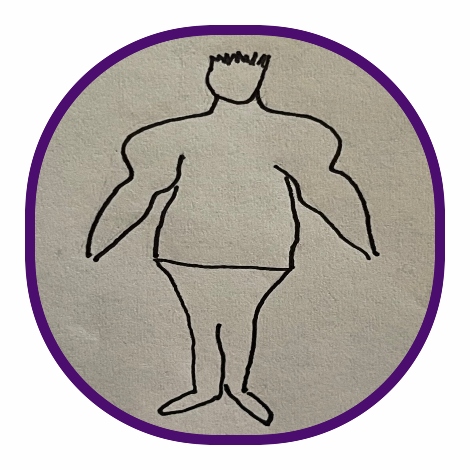
By summer, the transformation seemed complete. One afternoon, he and his family walked down the hallway on their way to the swimming pool. “Walked” is generous—he lumbered, unable to lower his arms fully because his torso had grown to mythic proportions. He wore only baggy shorts (I cannot call them trunks), his thick thighs rubbing together and his calves looking like chicken legs. It looked like it hurt him to move his legs, and for that moment I felt sorry for him. His pre‑tween daughter wore a bikini so revealing it made me blink twice in embarrassment. His wife and son, ironically, were dressed modestly befitting a church picnic.
His upper body had become enormous, his thighs still pronounced, his calves still comically thin. He reminded me of a Greek statue carved by an artist who ran out of marble halfway through. It was unsettling, the kind of physique that makes you instinctively step aside in case it topples or explodes.
He strutted through the building with the air of a man fishing for admiration, or perhaps for something more. Someone once told me that people who leave one addiction often find another to replace the high. Maybe this was that; maybe it wasn’t. I’m not his confessor; I can only pray for him.
What I do know is this: the greater his muscles grew, the quieter his preaching rang. There was a disconnect between the man he proclaimed himself to be and the man he was becoming, between the humility of the Gospel and the vanity of the mirror.
And perhaps that is the real caution of the Age of Adonis: when the body becomes the altar, the soul is left without a place to kneel and worship the one true God.
Part 2 will be published on April 16, 2026.

 Susan Marie Molloy