

Designing my own Catholic home altar has become a meaningful way of inviting God into the very structure of my daily life. As I began gathering the simple elements, I was shaping a small sanctuary, a place where prayer could take root and where the presence of God could be honored with intention. Every Catholic family in Scripture kept a sacred space, and creating one today continues that ancient rhythm of setting aside a place for the Lord. This altar is my quiet declaration that faith is not confined to Sunday Mass and Holy Days of Obligation; it belongs in the heart of the home, woven into ordinary moments. By building this space with reverence and simplicity, I am telling God that He is welcome here, that this home belongs to Him, and that I desire His peace to rest upon all who enter.
In the Catholic tradition, when you create a small altar in your home, you are making a quiet but profound declaration to God that He is welcomed and revered. It becomes a visible invitation to Grace, a designated space where the heart can turn toward God, and a daily reminder that the Lord dwells within your household. By setting aside even a small corner for sacred things, you are weaving prayer into the structure of your home and allowing faith to take up its rightful place at the center of your family’s life.
1. Choose a Quiet and Private Spot
Select a small, accessible space in your home where silence naturally gathers—a corner of your bedroom, a nook in the living room, or a place where the household’s noise rarely intrudes. A home altar flourishes in an atmosphere of calm, where the heart can settle and prayer can rise without distraction. If possible, choose a spot touched by natural light, for sunlight has a way of softening the space and reminding us of God’s gentle presence. A corner can also offer a sense of enclosure and privacy, creating a miniature sanctuary within the larger home. What matters most is that this becomes a place you return to daily, even briefly, allowing it to anchor your rhythm of prayer and keep your heart oriented toward God throughout the day.
2. Select a Clean Table or Shelf
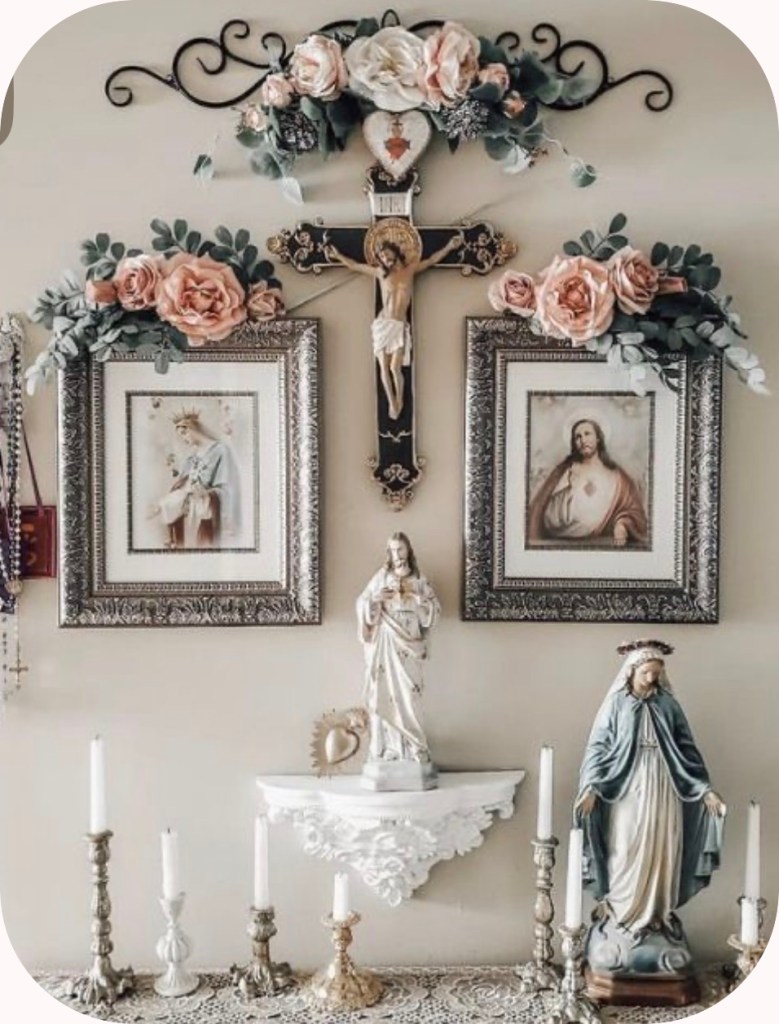
Choose a simple, stable surface that can serve as the foundation of your little sanctuary. This may be a small table, a sturdy shelf, or even a repurposed nightstand— what matters most is that it is clean, uncluttered, and set apart specifically for prayer. In the Catholic tradition, the beauty of a sacred space often begins with reverence for the ordinary, and preparing this surface becomes an act of devotion in itself. Many people place a pure white linen cloth, a crocheted doily, or a table scarf over the altar, echoing the linens used in our churches and symbolizing purity, dignity, and the presence of Christ. This small touch elevates the space, reminding you that this is not just furniture but a place where heaven and home meet.
3. Place the Crucifix at the Center
At the heart of every Catholic home altar stands the Crucifix, for it is the clearest sign of the love that redeems us. Whether placed directly on the table or reverently hung on the wall above it, the Crucifix becomes the focal point of the entire space. Its presence anchors the altar in the mystery of Christ’s Passion, reminding you that every grace, every blessing, and every moment of consolation flows from His sacrifice on the Cross. By placing the Crucifix at the center, you are placing Christ at the center—of your prayer, your home, and your daily life. Each time you pause before it, you are invited to remember His mercy, to unite your own sufferings with His, and to draw strength from the One who gave everything for your salvation.
4. Add a Catholic Bible
Place a Catholic Bible beside the Crucifix, giving the Word of God a place of honor within your home sanctuary. An excellent choice is the Douay–Rheims Bible for its beauty, reverence, and fidelity to Catholic tradition. By setting the Scriptures at the heart of your altar, you are making a clear declaration that your home is grounded not in shifting human opinions or passing cultural trends, but in the eternal truth revealed by God. The presence of the Bible invites you to read, meditate, and listen daily to the voice of the Lord, allowing His Word to shape your thoughts, guide your decisions, and sanctify the rhythm of your household.
5. Add Sacred Images
Sacred images help your home altar reflect the communion of saints and the beauty of our Catholic faith. You may place small statues or framed holy pictures of the Holy Family, your patron saints, or favorite Scripture scenes either on the altar itself or arranged reverently on the wall above it. These images are not meant to clutter the space but to gently lift the mind and heart toward God. Choose only a few, keeping the arrangement simple, orderly, and beautiful. Let each image serve as a quiet reminder that you pray in the presence of heaven, surrounded by those who intercede for you and accompany you on your journey of faith.
6. Add a Rosary
A Catholic home is never complete without a Rosary, for it is one of the Church’s most powerful spiritual weapons. The Rosary places your home under the protection of Our Lady, who always leads her children closer to Christ. You may hang it reverently on the wall above the altar or lay it gently upon the cloth, or in a specially designed receptacle, allowing it to rest near the Crucifix and the Scriptures. Its presence is a quiet invitation to prayer, reminding you to turn to Mother Mary in moments of need, gratitude, or discernment. Each bead is a pathway to contemplation, and by keeping the rosary at your altar, you anchor your home in the rhythm of meditating on the life of Jesus through the heart of His Mother.
7. Add a Candle and Holy Water
A candle on your home altar symbolizes the Light of Christ, where His presence shining in the darkness and His guidance illuminating your daily path. Lighting it during prayer becomes a small act of faith, a reminder that Jesus is the true Light who never fails His children. Alongside the candle, place a small container or font of holy water. This sacramental recalls your Baptism, your identity as a child of God, and the spiritual protection given to you through the Church. It also serves as a quiet reminder that the Christian life involves a real battle against sin and the influence of the Evil One, and that God equips His people with grace for that battle. Blessed beeswax candles are especially fitting for a home altar because of their purity and long tradition in Catholic worship. However, if safety is a concern, a beautiful battery‑operated candle can still provide a gentle, prayerful glow. What matters most is that these elements draw your heart toward Christ and help make your altar a place of reverence and peace.
8. Dedicate the Altar
Once your home altar is arranged, take a quiet moment to dedicate it to God. This does not need to be elaborate; a simple, sincere prayer is enough to set this space apart for holy use. You might thank the Lord for His presence in your home, ask for His peace to rest upon all who pray there, and invite Him to make this corner a place of grace, protection, and daily renewal. While it is a beautiful tradition to have a priest bless the altar when possible, you do not need to wait in order to begin using it. Your prayer of dedication opens the space to God’s work in your life, preparing your heart for the day when the Church’s blessing can be added to your own offering.
9. Keep It Clean and Respectful
A home altar is a sacred space, and it should be treated with the same reverence you would show in a church. Resist the temptation to let it become a resting place for keys, phones, mail, or anything unrelated to prayer. Clutter distracts the mind and diminishes the sense of holiness the altar is meant to hold. Only sacred items—your Crucifix, Bible, rosary, holy images, and sacramentals—belong there. By keeping the space clean, orderly, and free from worldly objects, you honor the presence of God in your home and preserve the quiet dignity of this little sanctuary. A tidy altar becomes an invitation to prayer, a reminder that this corner of your home is set apart for the Lord alone.
10. Pray There Daily
A home altar becomes truly alive when it is used regularly. You do not need long or elaborate prayers; what matters most is the steady rhythm of returning to God each day. Even a few quiet moments offered with sincerity can sanctify the entire household. You may begin and end your day here with simple morning and evening prayers, or pause during the day to pray the Rosary, linger over a Psalm, or read a passage from the Bible. Novenas, litanies, and spontaneous prayers also find a natural home in this sacred space. The goal is not perfection but faithfulness—allowing this little corner to draw your heart back to the Lord again and again, until prayer becomes the gentle heartbeat of your home.
11. Consistency Keeps Peace in the Home
A home altar bears fruit only when the heart that approaches it is striving for peace. If resentment, anger, or bitterness are allowed to fester and take root, the altar becomes little more than decoration. But when you return to it faithfully day after day, even in small ways, it begins to transform the atmosphere of your home. Grace softens tempers, temptations lose their strength, and the household slowly learns a rhythm of reverence. Children absorb what they see: a parent who prays, forgives, and seeks God becomes their first catechism. Visitors, too, can sense the quiet peace that settles over a home where the Lord is honored. A true Catholic home altar does not merely occupy space; it sanctifies it. God dwells where He is welcomed, and a consistent life of prayer opens the door for His presence to shape the entire household.
12. Add Liturgical Seasonal Elements
Incorporating liturgical seasonal elements into your home altar helps your prayer life stay connected to the rhythm of the Church’s liturgical year. During Advent, you might place a small wreath, a purple and rose-colored ribbon, or a single candle of expectation. At Christmas, a tiny Nativity scene or a white cloth can reflect the joy of Christ’s birth. Lent invites simplicity—perhaps a violet cloth, a crucifix draped in purple, or a small bowl of ashes to symbolize repentance. Easter calls for brightness: flowers, a white cloth, or a small image of the Resurrection. Even Ordinary Time has its quiet beauty, often marked with green to symbolize growth in virtue. These gentle changes keep your altar alive, reminding your heart that the Church moves through seasons of waiting, sorrow, joy, and renewal, and your home can move with her.
May this home altar become a wellspring of grace for you and all who dwell under your roof. May Christ, whose Cross stands at its center, fill your days with mercy, strength, and quiet courage. May the Holy Spirit guard your home with peace that the world cannot give. May Our Lady wrap your family in her mantle and lead you ever closer to her Son, and may every prayer you offer in this sacred space rise like incense before the throne of God, sanctifying your home, softening your heart, and drawing you deeper into His love. May the blessing of Almighty God, Father, Son, and Holy Spirit, rest upon your household and remain with you always.
Pacem in terris.
January 26, 2026 – Saint Polycarp, Bishop and Martyr.
 Susan Marie Molloy
What are your opinions? I would like to read them.